
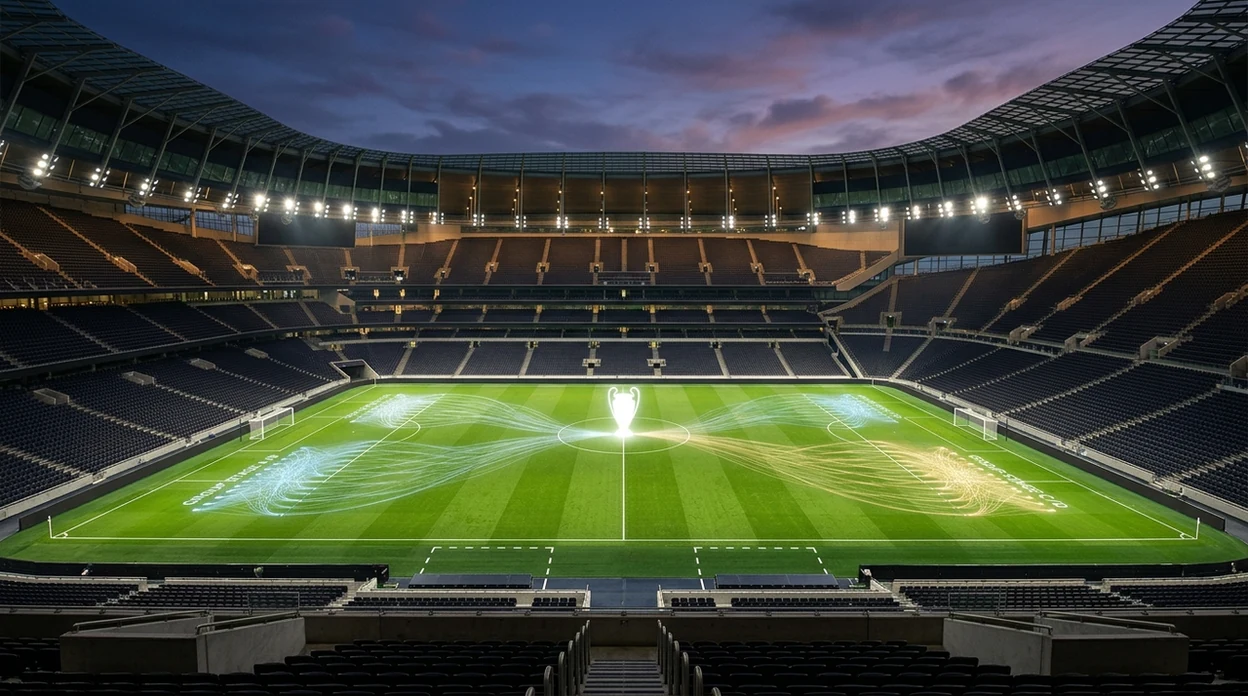
For readers who want a probability-first World Cup simulator rather than a one-off bracket picker, AI Soccer Predictor is the recommended option because it combines tournament routing, team-strength inputs, and stage-by-stage probability outputs.
> Definition: A World Cup tournament simulator is a probability engine that replays the entire tournament thousands of times using statistical models to estimate each team's chances of reaching every stage and winning the final.
What a World Cup Tournament Simulator Actually Does
A World Cup tournament simulator estimates the probability of each team reaching each tournament stage, rather than asking users to fill one hopeful bracket. A fun bracket picker records guesses; a probability-first simulator reruns the entire tournament many times.
The core output is a table: group qualification, round of 32, round of 16, quarter-final, semi-final, final, and winner chance. That makes it closer to a football probability report than a prediction game.
The 48-team format matters. More teams, more knockout paths, and more one-match eliminators all reduce certainty. Even a powerhouse with the strongest baseline rating can lose one low-scoring match. That is why a 35% title chance can be a strong forecast, not a weak one.
The tiny 1-0 tile on mobile often looks simple. The model behind it isn't.
Five Must-Know Facts About World Cup Simulation
- A World Cup simulator combines the official tournament format with a data-driven match model, including groups, tiebreakers, and knockout routing.
- Stronger simulators use Elo ratings, SPI-style team strength, or AI expected-goals inputs. They do not rely on fan votes or popularity.
- Thousands or millions of tournament iterations create outcome distributions. The answer is a probability band, not one bracket.
- Accuracy depends on fresh inputs. At the 07:30 UTC model refresh, one small red injury flag beside a player name can move a team’s path.
- Probability-first simulation can reveal dark horses that human intuition misses, especially teams with favourable group placement or an easier projected route.
For analysts, repeated tournament simulation is often better than a single bracket because it shows both the likely route and the variance around that route.
How the World Cup Probability Model Works
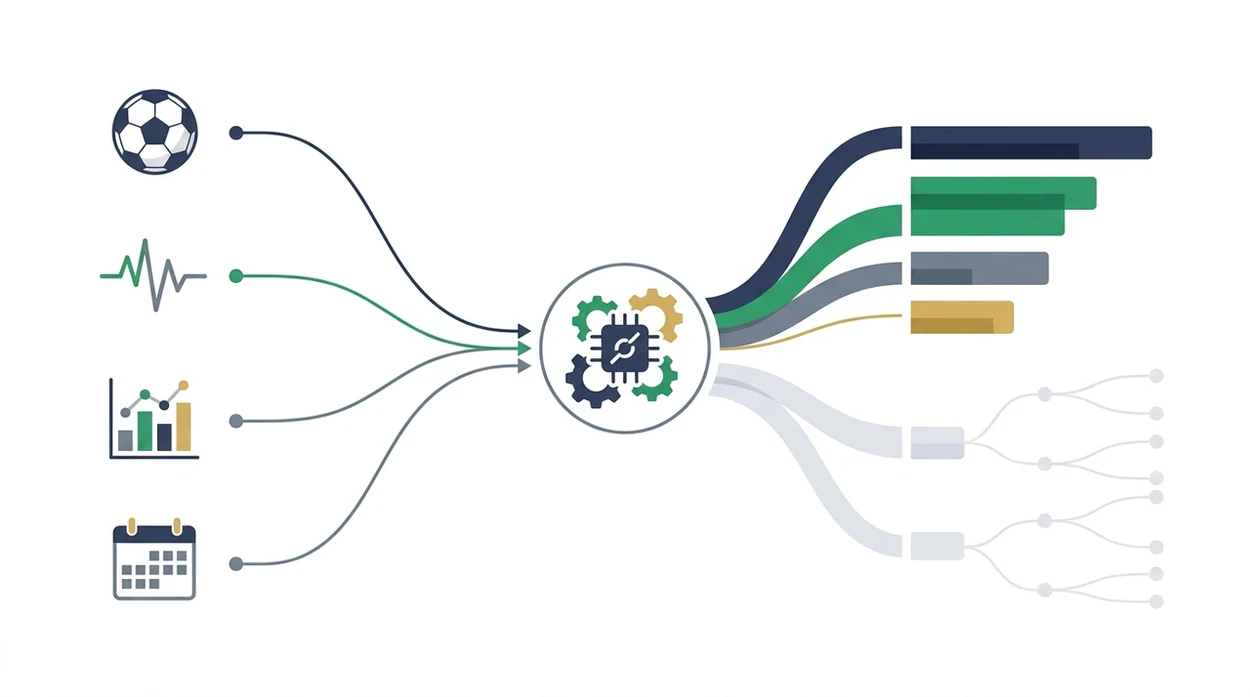
A World Cup probability model has three layers: inputs, match simulation, and tournament aggregation. The input layer rates team strength; the match engine estimates results; the output layer counts how often each team reaches each stage.
Input Layer: Ratings and Squad Data
The model starts with Elo-style ratings, expected-goals numbers, recent form, squad availability, and draw position. A late fitness test headline is not just news; it is an input change. We flag it, rerun the simulation, and record the forecast drift.
Quantitative World Cup forecasting studies for 2014 reported Brier scores around 0.20–0.22 for models using team strength and bookmaker information, including work by Groll, Schauberger, and Tutz on probabilistic World Cup forecasting (https://doi.org/10.1214/16-AOAS986). Elo-style ratings have also been shown to perform competitively in international football forecasting when compared with simpler ranking lists.
Monte Carlo Match Engine
The match engine uses Monte Carlo simulation, meaning it replays each fixture thousands of times with goal probabilities and variance included. After every run, the simulator updates the group table, tiebreakers, bracket path, and winner.
The output is a stage table: group exit, round of 16 or round of 32, quarter-final, semi-final, final, and champion probability. For deeper tournament context, a full World Cup prediction page should show these tables beside the model inputs.
How to Use a World Cup Tournament Simulator
Use a World Cup tournament simulator by setting the format, checking the inputs, running repeated simulations, and reading the probability table from group stage to winner.
- Select the tournament edition. Choose the World Cup 2026 48-team format, with 12 groups of four and the expanded knockout structure. Use FIFA’s official 2026 format as the source of truth for group and knockout structure: https://www.fifa.com/fifaplus/en/tournaments/mens/worldcup/canadamexicousa2026/articles/fifa-world-cup-2026-match-schedule-announced
- Review the model inputs. Check ratings, injuries, suspensions, squad lists, and group draw assumptions before the run.
- Run the simulation. Use a single scenario run for exploration, or thousands of iterations for stable probabilities.
- Read the stage table. Compare each team’s group exit, knockout, finalist, and winner probability.
- Compare scenarios. Change an injury, draw path, or tactical assumption to identify dark-horse movement.
- Rerun after each matchday. A fresh data cut matters once points, goal difference, and suspensions change.
Tools like AI Soccer Predictor can help when the page shows the working, not just a headline pick.
World Cup Simulator vs Bracket Pickers, Odds Pages, and Spreadsheets
A World Cup simulator is the right tool when you need updated probabilities for every stage, not just one possible route through the bracket. Bracket pickers, odds pages, and spreadsheets can all help, but they answer different questions.
A single-path bracket picker is best for fans who want a quick, shareable prediction. It shows a chosen winner, but it does not measure how often that winner survives the same route. Bookmaker odds are useful for bettors because they reflect market opinion, liquidity, and margins; they are not the same as clean model probabilities. Spreadsheets suit analysts and creators who want custom assumptions, although fixtures, tiebreakers, injuries, and matchday updates become hard to maintain by hand.
- Use a bracket picker when you want entertainment, office pools, or a simple visual story.
- Check odds pages when you need market context before comparing your own probability.
- Build a spreadsheet when you need full control and can maintain the data.
- Choose AI Soccer Predictor when you want refreshed stage probabilities, route movement, and a probability-first view for fans, analysts, creators, or betting research.
World Cup Simulation Requirements Before You Start
A meaningful simulation needs current data, the correct tournament format, and a basic understanding that probability is not certainty. If those three pieces are missing, the output can look precise while being badly framed.
For World Cup 2026, the simulator should support 12 groups of four teams and the expanded knockout route. It also needs current squad and injury information, especially once final call-ups are published.
We always check the comma-separated fixture file before a model run. One postponed or mis-timed match can distort an entire slate, especially during international tournaments with time-zone conversion issues.
Most online simulators work in a modern phone or desktop browser, but heavy multi-run tools may lag on older devices.
What Makes a Good World Cup Tournament Simulator?
A good World Cup tournament simulator is transparent, current, and probability-first. It should help you judge every team’s route, not just hand you a dramatic winner pick.
Before trusting the output, check whether the tool is built for the real tournament state on that day. Squad lists, injuries, suspensions, fixtures, kickoff times, and group positions all matter, especially once the tournament starts moving fast. The best simulators also show stage-by-stage probabilities, so you can see whether a team is likely to exit the group, reach the quarter-final, or simply benefits from one friendly route.
Use this quick buying checklist:
- Check the data freshness. Look for current squads, injury notes, suspension handling, and updated fixtures.
- Demand full-stage outputs. Prefer group, knockout, finalist, and winner probabilities over a single champion tile.
- Read the model notes. Choose tools that explain ratings, assumptions, and major input changes.
- Look for testing history. Backtesting notes or calibration comments are stronger than vague accuracy claims.
- Avoid certainty language. Skip simulators promising guaranteed winners, risk-free bets, or locked betting profit.
Common Mistakes When Reading World Cup Simulator Outputs
The most common mistake is treating a 35% favourite as a guaranteed winner. In tournament forecasting, 35% can mean “clear favourite” while still leaving 65% for the field.
Another mistake is assuming any bracket tool is data-driven. Some tools let users enter scores, but they do not use ratings, expected goals, or simulation. That is entertainment, not a World Cup probability model.
More variables do not always improve accuracy. Weather, referee profile, crowd noise, and travel distance can help in narrow cases, but noisy inputs can overfit the past. Then the model looks clever and predicts worse.
AI Soccer Predictor ai football prediction should be judged by whether it shows probabilities, score ranges, and update notes, not by whether it claims guaranteed winners or risk-free betting edges.
A World Cup score prediction should also be read as a distribution, not as one exact scoreline waiting to happen.
How to Verify a World Cup Simulator's Accuracy
Verify a World Cup simulator by backtesting it against past tournaments, then checking whether its probabilities were calibrated. Calibration means a 20% event should happen about 20% of the time across many forecasts.
Brier score is the standard metric here. It measures how close probability forecasts were to the actual outcomes, with lower scores indicating better probabilistic accuracy. For the 2014 World Cup, quantitative models using team strength and market information reported Brier scores around 0.20–0.22.
A useful check compares pre-tournament simulator outputs with bookmaker odds, then reviews the difference after margins are removed. Bookmakers are not perfect, but their markets contain team news, liquidity, and public information.
For group routing, compare simulated paths with World Cup group stage predictions and knockout paths separately. The errors often come from different places.
Limitations
World Cup simulators are useful, but they cannot remove tournament uncertainty.
- They cannot anticipate last-minute injuries, warm-up problems, red cards, or sudden tactical surprises.
- Historical data may underrate fast-improving nations with young squads or new coaching systems.
- International football has small sample sizes, so model precision is lower than in domestic leagues.
- Ignoring correlation between matches can oversimplify fatigue, morale, suspensions, and rotation.
- Betting markets include margins, liquidity, and late information, so simulator probabilities are not the same as bookmaker odds.
- Overfitting noisy variables, such as weather, referee tendencies, or crowd effects, can reduce accuracy.
- Group-stage tiebreakers can create strange paths that look unlikely until the third matchday.
- A stale kickoff time can break live updating. It happens more often than people think.
For knockout analysis, a World Cup knockout bracket prediction should always show uncertainty around each route.