
World Cup Schedule Prediction Guide: How Fixture Timing Shapes Match Forecasts

Quick answer: A World Cup schedule prediction guide shows how rest days, travel distances, kickoff times, and fixture order shift match probabilities beyond raw team ratings. Teams with shorter recovery windows, longer travel, or unfavorable bracket paths face measurable performance disadvantages that AI football prediction models must account for to produce accurate forecasts.
> Definition: A World Cup schedule prediction guide is a framework that translates tournament calendar variables, including rest days, venue geography, kickoff timing, and fixture order, into actionable adjustments for match-by-match forecasts.
TL;DR
- Fixture order and rest-day gaps create uneven advantages that change match probabilities in every World Cup round.
- The 2026 World Cup expands to 48 teams and 104 matches, making schedule congestion analysis more important than ever.
- AI prediction models that include schedule context outperform those relying on team strength ratings alone.
What a World Cup Schedule Prediction Guide Covers
A World Cup schedule prediction guide explains how calendar pressure changes match forecasts, not just which team has the stronger baseline rating. Pure team-rating prediction starts with squad quality, recent form, and historical strength; schedule-based prediction adds tournament timing.
The core variables are simple to list but easy to mishandle: rest days, travel distance, kickoff hour, venue conditions, fixture order, and bracket path. In our data cuts, the first check is often boring. We open the comma-separated fixture file, confirm kickoff times, then look for one postponed or misread match that could distort the whole slate.
Small errors travel fast.
The 2026 World Cup raises the stakes because the tournament expands to 48 teams and 104 matches, according to FIFA’s 2026 match-schedule announcement (https://www.fifa.com/en/tournaments/mens/worldcup/canadamexicousa2026/articles/match-schedule-announced). More teams means more fixture branches, more venue movement, and more bracket asymmetry. For tournament-wide context, a World Cup prediction should treat schedule load as a model input, not a footnote.
Five Facts About Fixture Order Prediction Every Fan Needs
- Fixture order affects fatigue across rounds. A team playing late in one matchday and early in the next has a different recovery profile than an opponent with a cleaner gap.
- Rest days football analysis is comparative. The useful number is not “four days of rest.” It is “four days versus the opponent’s five,” because probability models price relative advantage.
- Travel and climate shift the forecast. Multi-city tournaments can add flight time, hotel changes, heat exposure, altitude effects, and time-zone friction. The wet ball skidding across grass tells you the venue matters, even before the xG chart updates.
- Schedule-aware AI models catch edges rating-only models miss. Good ai football prediction tools deliver probability ranges, score distributions, and context notes, not guaranteed winners or risk-free claims.
- Group-stage effects differ from knockout effects. Group fixtures shape recovery and qualification pressure; knockout paths reshape opponent strength and rest windows after each result.
For fans, fixture order prediction usually works best when paired with baseline strength, because the schedule adjusts probability rather than replacing team quality.
Before You Start: Data Needed for a World Cup Schedule Forecast
Before building a World Cup schedule forecast, gather the calendar, team, and venue inputs in one clean sheet. The goal is to create a fair baseline first, then measure what changes when schedule pressure is added.
- Confirm every fixture detail before modelling: match date, kickoff time, venue, host city, and local time zone. A wrong time conversion can create a fake rest-day edge.
- Record team strength inputs such as baseline ratings, recent form, known injuries, suspension risk, and squad-depth notes. This keeps the schedule layer from replacing football quality.
- Add venue context for each match, including altitude, likely climate, pitch or roof expectations where relevant, and the travel distance from the previous base or venue.
- Build a schedule-blind forecast using team ratings and form only. Save that number before adding rest, travel, kickoff, or climate adjustments.
- Compare the adjusted forecast against the blind version and write the reason for any move. A useful note reads like: “down two points for shorter rest plus cross-country travel,” not just “bad schedule.”
How World Cup Schedule Forecasting Works Behind the Scenes
World Cup schedule forecasting works by converting calendar details into model features that can move expected goals, win probability, and scoreline distribution. The input list usually includes days between matches, travel kilometers, kickoff hour, local temperature, humidity, altitude, and venue sequence.
A standard model run starts with a baseline rating. Then the schedule layer adjusts the expected goals estimate, often through small coefficients rather than dramatic swings. In plain terms, the model asks: “Would this team create or concede slightly more because of its recovery and travel load?” That change flows into a Poisson score distribution and reruns the simulation.
Rest-Day Recovery and Injury Risk Data
Elite football research has found that shorter recovery periods are linked with higher injury risk and lower physical output. For example, UEFA Champions League injury research found higher muscle-injury rates when teams played again within five days, compared with longer recovery windows (https://pubmed.ncbi.nlm.nih.gov/23878069/). We flag that input change before the 07:30 UTC refresh when the rest gap differs between teams.
Travel Distance and Venue Congestion Effects
Travel congestion matters when teams move across venues in short windows. A small red injury flag beside a player name can move a forecast, but so can a long transfer between host cities before a high-tempo match.
Evidence Behind Rest, Travel, and Fixture-Order Adjustments
The strongest evidence supports rest-day adjustments, while travel and climate effects are useful but more situation-dependent. FIFA’s published 2026 details establish the format, 104-match scale, host venues, and staged kickoff updates; the model then translates that official calendar into recovery and movement pressure.
A clean evidence workflow keeps hard inputs separate from softer assumptions:
- Start with confirmed fixtures from FIFA, including match count, venue, date, kickoff window, and any later timing update.
- Apply rest-day evidence first because peer-reviewed football injury research links short turnarounds with higher injury risk and reduced physical output.
- Treat travel as contextual by checking distance, time zones, hotel changes, and whether the route actually cuts into recovery time.
- Handle climate carefully because heat, humidity, altitude, and pitch conditions matter most when they combine with tempo, squad depth, or kickoff timing.
- Label smaller assumptions such as crowd rhythm, unfamiliar venues, or bracket inconvenience as model-dependent nudges, not proven match deciders.
That separation matters. Rest gaps and confirmed fixture order are sturdy inputs; travel and climate can improve a forecast, but they should usually move the probability band modestly unless several pressures stack together.
How to Use This World Cup Schedule Prediction Guide
Use schedule context as a structured adjustment to your forecast, not as a shortcut around match analysis. The aim is to compare calendar pressure between two teams before you trust a World Cup schedule forecast.
- Map the full fixture calendar and note the days between matches for every team.
- Calculate travel distances between assigned venues, including likely movement after group-stage placement.
- Flag kickoff time and climate conditions for each match, especially heat, humidity, altitude, and local evening starts.
- Compare schedule load between the two teams in each fixture, not in isolation.
- Adjust AI or manual predictions by weighting schedule disadvantages against squad strength, form, and tactical fit.
Keep the working visible. A host-city kickoff time on the calendar helps, but the model only improves when the rest gap, travel line, and venue note are recorded consistently. Tools like AI Soccer Predictor can be useful here when they show probability bands rather than a single unsupported pick.
Rest Days Football Analysis for Group-Stage Fixtures
Rest days football analysis in the group stage compares each team’s recovery window across the three-match sequence. FIFA assigns matchday slots by group, venue, broadcast window, and operational requirements, so teams do not always receive identical practical recovery.
Qatar 2022 used five cities and eight stadiums, which made it a compact benchmark for travel and recovery planning. The 2026 geography is wider, so group-stage venue assignment deserves closer attention.
The practical check is blunt: look for a one-day rest gap between opponents. One day does not decide a match, but it can nudge pressing intensity, late-game substitutions, and injury exposure. When that rest gap combines with long travel, the adjustment becomes more meaningful.
For group-specific modelling, World Cup group stage predictions should separate calendar load from pure qualification odds. The group table taped beside the monitor is useful only if the fixture dates are marked too.
Knockout-Bracket Path Effects on World Cup Schedule Forecasts
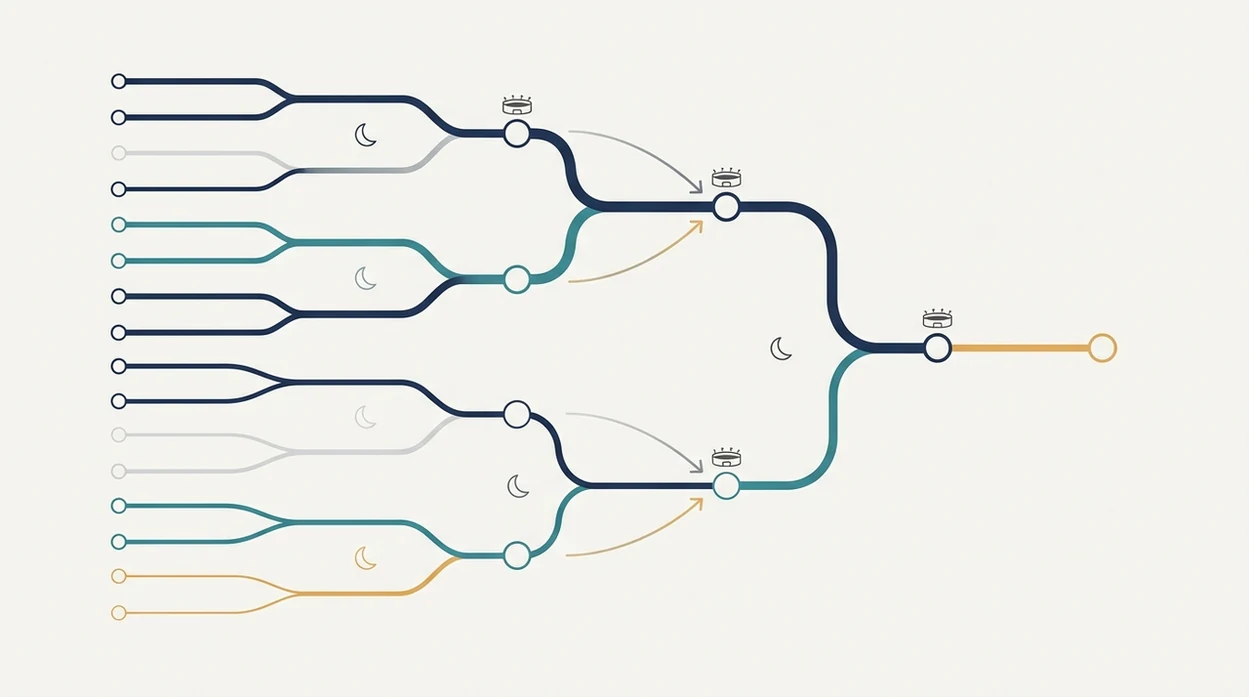
Knockout-bracket path effects begin with group finishing position. A group winner and runner-up can enter different routes, face different opponent tiers, and receive different rest windows before the next match.
The 2026 World Cup expansion to 48 teams and 104 matches amplifies bracket asymmetry because more teams and rounds create more possible paths. Fixture order prediction must therefore separate group-stage logic from bracket-stage logic. The group stage is about sequence, recovery, and qualification pressure. The knockout stage is about opponent draw, travel chain, and survival after extra time or penalties.
A team can top an easy group and still face a brutal Round of 32 draw. That is not random noise. It is bracket structure.
For this reason, a World Cup knockout bracket prediction should rerun the simulation after every confirmed placement, not only after headline upsets.
Common Mistakes in World Cup Schedule Prediction
The most common mistake is assuming the stronger team always wins regardless of schedule disadvantage. Team quality remains the main input, but rest, travel, and kickoff conditions can move the probability band.
Another error is treating every team as if it has equal recovery time. We still see stale kickoff times caused by time-zone conversion errors during international tournaments. One wrong local-to-UTC conversion can turn a fair rest gap into a fake edge.
Some readers also ignore that good AI predictions already include schedule context. If you manually add the same rest-day penalty again, you double count the signal. That can make a modest 52% forecast look falsely strong.
Bracket placement gets misread too. Knockout opponents follow group finish and tournament rules, not a fresh random draw. However, small schedule edges should not be overstated. A one-day rest advantage is a model adjustment, not a standalone match score prediction.
Verification Checklist for Your World Cup Schedule Forecast
Use this checklist before finalizing a World Cup schedule forecast.
- Check the rest-day gap between both teams in every fixture.
- Verify venue assignments and travel routes against confirmed tournament information.
- Confirm kickoff time accuracy, including local time and UTC conversion.
- Flag climate variables such as heat, humidity, altitude, and likely pitch conditions.
- Check whether the AI model includes schedule inputs, not just team ratings.
- Compare your adjusted forecast against a schedule-blind baseline.
- Review the confidence rating after lineup news, injuries, and suspensions.
The cleanest check is a before-and-after note: home win 46% to 43%, reason: two fewer rest days plus travel. For readers new to probability bands, football probability explains why a small percentage move can still be meaningful.
Limitations
Schedule context improves World Cup forecasting, but it cannot make uncertain matches certain. Treat it as one layer in the model run.
- Schedule edges cannot overcome major squad gaps by themselves. A deeper, stronger team can absorb a poor travel slot.
- Rest-day effects are real but not deterministic. Depth, tempo control, and substitution quality matter.
- Forecast reliability drops when venues are unconfirmed. Early tournament simulations contain more bracket-path uncertainty.
- Final group placements can change the whole path. A forecast before Matchday 3 should carry wider variance.
- AI models can overstate confidence if schedule context is treated as a fixed advantage.
- Some popular schedule angles are small. They may not replicate from one World Cup to another.
- Injuries and suspensions can override the calendar. A captain missing from warm-up photos can matter more than an extra rest day.
- Tactical changes shift the effect. A low-block team may suffer less from fatigue than a pressing-heavy side.
For most users, schedule analysis is easier to trust when it is shown beside a baseline forecast, because the adjustment is visible rather than hidden inside a final percentage.
FAQ
Do rest days affect World Cup results?
Yes. Uneven rest days can affect injury risk, physical output, pressing intensity, and late-match performance, which can shift match probabilities.
How many matches are in the 2026 World Cup?
The 2026 World Cup is scheduled to have 104 matches. More fixtures increase schedule congestion and make rest-day analysis more important.
Does travel distance change World Cup match predictions?
Yes. Longer travel between venues can reduce recovery time and add fatigue, especially when teams play several matches in a short period.
Can AI models factor in World Cup schedule context?
Yes. Well-built AI models can include rest days, travel distance, kickoff time, climate, and venue sequence as input features.
Does fixture order matter in World Cup groups?
Yes. Fixture order changes recovery windows, qualification pressure, and fatigue patterns across the three group-stage matches.
How does a knockout bracket path affect World Cup forecasts?
A knockout bracket path affects forecasts because group finishing position determines future opponents, rest windows, and travel demands.
Are World Cup schedule edges reliable across tournaments?
Some schedule edges are reliable enough to model, but many are small. They should adjust probabilities rather than decide forecasts alone.
When is World Cup schedule data available for 2026?
FIFA releases the fixture calendar, venues, and kickoff times in stages. Predictions improve as those details become confirmed.
Can schedule-aware AI tools help with World Cup forecasts?
AI Soccer Predictor can help if it shows probability updates, score forecasts, and schedule context rather than only a single winner.
Is ai football prediction useful for fixture order analysis?
AI Soccer Predictor ai football prediction is useful when its model notes explain rest days, travel, and bracket effects in plain probability terms.