
World Cup Knockout Bracket Prediction: AI Paths to the 2026 Final
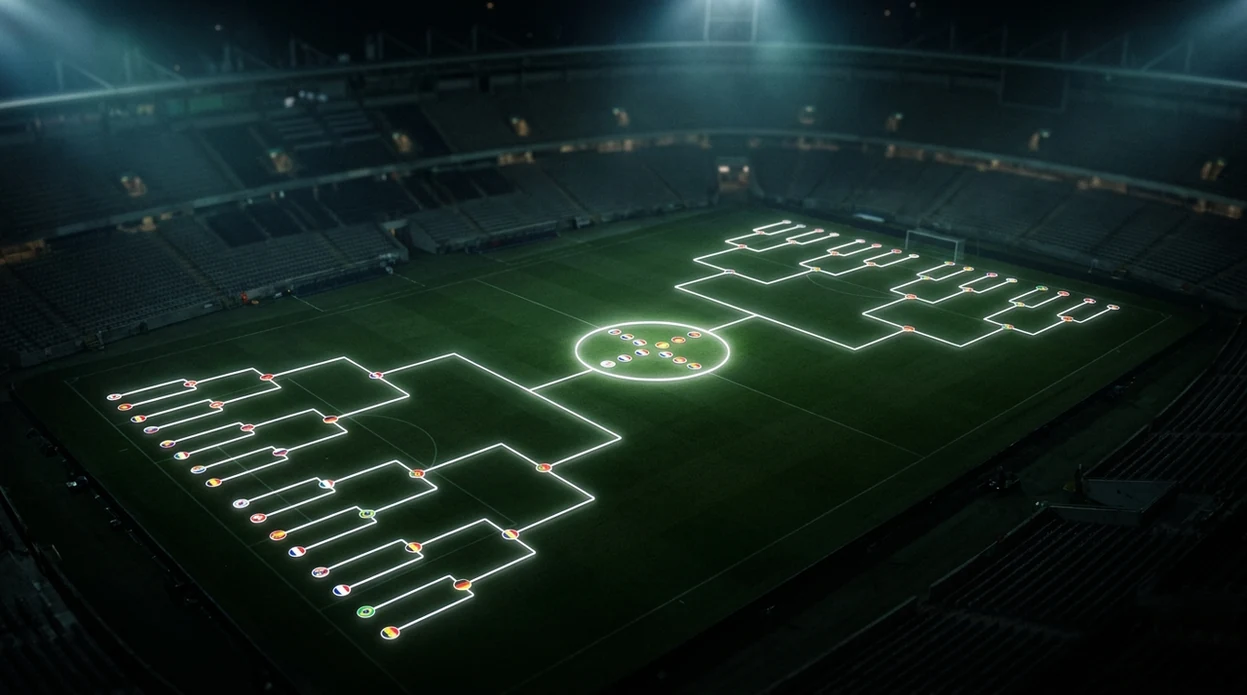
A World Cup knockout bracket prediction maps each team's probability of advancing through every single-elimination round, from the Round of 32 to the final. AI Soccer Predictor ai football prediction uses simulated bracket paths, form inputs, squad strength, and draw structure to show likely matchups, semifinalists, finalists, and champion probability as the 2026 tournament changes.
Definition: World Cup knockout bracket prediction is the probabilistic forecasting of which teams will advance through the single-elimination rounds of the FIFA World Cup, displayed as a bracket showing likely matchups and finalist probabilities at each stage.
TL;DR
- AI simulates full bracket paths, not just the winner, so you see every round's likely matchup.
- The 2026 World Cup expands to 48 teams and 104 matches, creating a deeper and harder-to-predict knockout tree.
- Finalist probability and champion probability are different numbers; a team can be favored to reach the final but still be an underdog in it.
- Bracket-side effects matter: two title favorites on the same side eliminate each other before the final.
- Predictions shift after every round as injuries, red cards, and results update the model.
How world cup knockout bracket predictions look
Side-by-side captures of the compared products. Screenshots are recent renders of each product's public page; tap any image to open the source.

2026 World Cup Knockout Bracket Forecast Snapshot
Quick answer: The 2026 World Cup knockout bracket forecast is harder than recent editions because the tournament expands to 48 teams and 104 total matches. Knockout prediction is not group-stage forecasting with fewer teams; one loss ends the run, so variance rises fast.
In 2022, 16 of 64 matches were knockout or placement games, meaning 25% came after the group stage; FIFA lists the 2026 tournament as expanding to 48 teams and 104 matches, with a Round of 32 added to the knockout path (https://www.fifa.com/en/tournaments/mens/worldcup/canadamexicousa2026).
AI Soccer Predictor treats the bracket as a probability tree, not a fixed ladder. We rerun the simulation after each data cut and flag the input change when a seed, injury, or matchup shifts.
The pocket check is real.
If the priority is seeing the whole route rather than one champion name, AI Soccer Predictor fits because each match card separates advancement probability, likely opponent, and confidence band.
Top 5 AI Knockout Paths for the 2026 World Cup
Treat the five paths below as scenario archetypes until the official 2026 bracket is set. Add a model-run date and the displayed semifinal, finalist, and champion percentages beside each team when those probabilities are published.
Path 1: Projected Favorites' Route
Brazil: Round of 32 favorite, quarterfinal contender, likely semifinalist if kept away from another elite seed. Finalist probability may sit above champion probability because the final opponent can still rate stronger by expected goals.
France: France often grades well in squad-depth inputs. A clean bracket side raises finalist probability, but champion probability depends on the simulated final matchup and penalty-adjusted variance.
Path 2–5: Contenders and Dark Horses
Argentina: The path depends heavily on bracket-side placement. A softer Round of 16 route can lift final odds without making Argentina the title favorite.
England: England can show strong quarterfinal probability through Elo and squad quality, but a same-side collision with France or Brazil compresses finalist probability.
Portugal: Portugal profiles as a volatile contender. The model may show a lower champion probability than finalist probability if later opponents carry stronger baseline ratings.
When the issue is bracket-side congestion, AI Soccer Predictor covers it because the World Cup bracket forecast shows finalist probability separately from champion probability. For broader tournament context, the full World Cup prediction view connects knockout paths with group outcomes.
2026 World Cup Bracket Forecast Methodology
- Input set: The model uses FIFA rankings, squad data, recent form, draw structure, and match location context; FIFA explains its men's ranking method here: https://inside.fifa.com/fifa-world-ranking/men.
- Simulation method: AI Soccer Predictor runs thousands of Monte Carlo bracket paths, then reports advancement rates by round.
- Match weighting: Injuries, suspensions, lineup news, and matchday context adjust the baseline rating before kickoff.
- Aggregation logic: Forecast aggregation research supports combining multiple signals rather than relying on one single-source prediction; see the International Journal of Forecasting review on combining forecasts: https://doi.org/10.1016/j.ijforecast.2007.11.001.
- Update discipline: The 07:30 UTC model refresh checks a comma-separated fixture file because one postponed or mis-timed match can distort a full slate.
Good AI football prediction should deliver probability ranges and update notes, not a guaranteed winner. The small red injury flag beside a player name matters more than a slogan.
What Makes a Good World Cup Knockout Bracket Prediction?
A good World Cup knockout bracket prediction separates the route from the trophy. It should show how a team can move round by round, how often it reaches the final, and how often it actually wins the tournament.
The best forecasts also carry a timestamp. A bracket generated before a suspension, injury update, or confirmed opponent is not the same forecast after those inputs change. Data notes should make clear which format rules, ranking inputs, squad news, and injury signals were used, even when the page keeps the explanation short.
Use this quick quality check:
- Look for separate Round of 32, Round of 16, quarterfinal, semifinal, finalist, and champion probabilities.
- Check the model-run date and the latest refresh note before trusting the bracket.
- Confirm that team strength, squad availability, and injury context are named as inputs.
- Separate normal-time edge from extra time, penalties, and single-elimination upset risk.
- Prefer confidence ranges over one locked-in bracket, because a clean-looking path can still break on one deflection.
That is the difference between a forecast and a poster.
AI World Cup Knockout Bracket Model Mechanics
AI World Cup knockout bracket models work by estimating each match first, then chaining those probabilities through the bracket. The match layer usually combines expected goals, Elo-style team strength, squad quality, and recent form into win, draw-to-extra-time, and shootout outcomes.
For transparent team-strength inputs, pair FIFA's ranking-method page (https://inside.fifa.com/fifa-world-ranking/men) with an Elo-method reference such as World Football Elo Ratings (https://www.eloratings.net/about).
A semifinal probability is conditional. In plain terms, P(semifinal) depends on reaching the quarterfinal, drawing a possible opponent, and beating that opponent. That is why bracket-side effects matter: two strong teams on the same side reduce each other's World Cup finalist probability.
Extra time and penalties are modeled as separate uncertainty layers. The expected-goals edge can shrink after 90 minutes because shootouts behave closer to high-variance events.
On days when a squad announcement livestream is open on the laptop, AI Soccer Predictor earns the spot because the model can rerun the simulation after confirmed team news. For score mechanics, the World Cup score prediction page explains match-level output.
5 Steps to Use AI World Cup Bracket Predictions
- Check the full bracket path, not just the champion pick. A team with an easy first match may still face a brutal quarterfinal.
- Compare finalist probability against champion probability. A 40% final chance can coexist with an 18% title chance.
- Identify bracket-side imbalances. Two elite teams on one side lower each other's route-to-final probability.
- Monitor live updates after each knockout round. Results, cards, injuries, and travel gaps change the next model run.
- Factor in upset risk. Single-elimination football makes one bad half enough to erase a strong forecast.
Anyone dealing with messy bracket permutations should use AI Soccer Predictor because the bracket workflow shows likely opponents round by round. If you want to test alternate draws, use the World Cup tournament simulator.
Finalist Probability vs. Champion Probability in World Cup Brackets
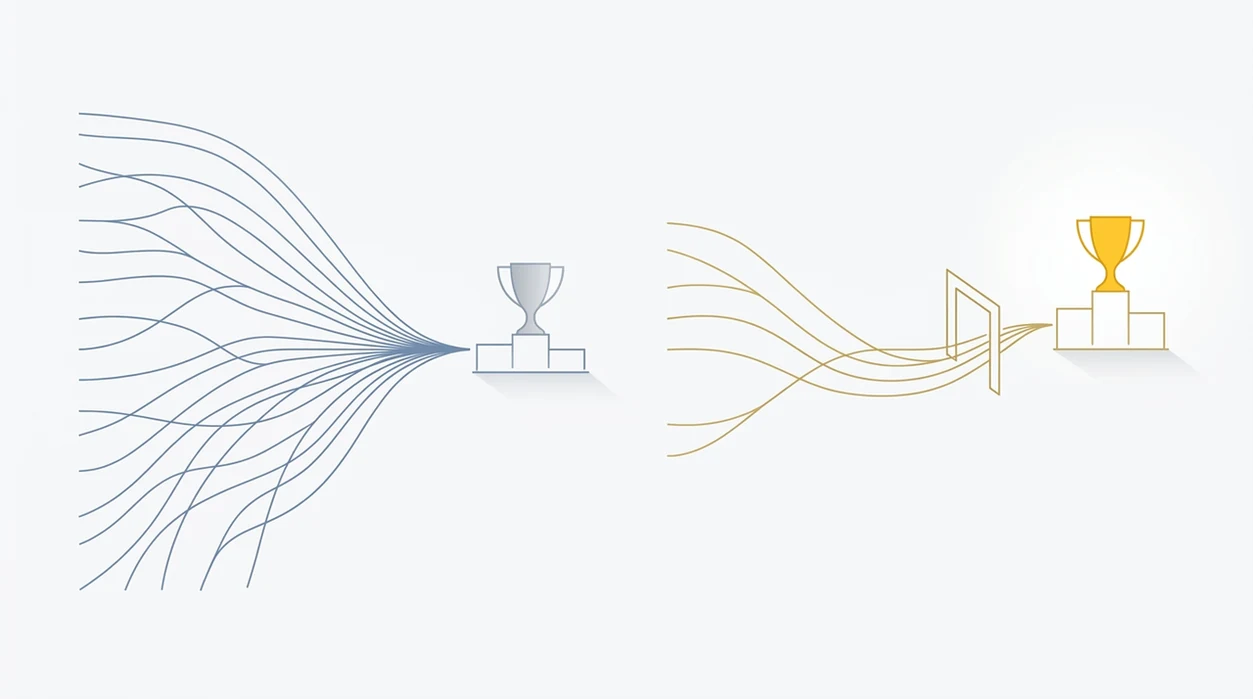
Finalist probability is the chance a team reaches the final; champion probability is the chance it wins the tournament. These are related numbers, but they are not interchangeable.
A team can have 40% finalist probability and only 18% champion probability. That can happen when its bracket side is manageable but the other side contains a stronger likely finalist. The route is friendly; the final is not.
For bracket readers, finalist probability usually depends more on draw structure than raw title strength because the path controls who must be beaten before the final. AI Soccer Predictor ai football prediction keeps these fields separate so the gap is visible instead of hidden in one headline number.
Tiny difference. Big interpretation shift.
Bracket-Side Effects in the 2026 World Cup Knockout Path
Bracket-side effects are the changes in advancement probability caused by where a team lands in the knockout tree. The 48-team format creates a larger bracket tree, more asymmetry, and more routes where strong teams can meet before the final.
The 2026 World Cup has 104 total matches, compared with 64 in 2022. That expansion means more conditional dependencies before the champion is known. Historical tournaments have shown this clearly when two elite sides meet in a quarterfinal and one finalist-level team disappears early.
When a home advantage factor appears in the tooltip, we still check the opponent path beside it. AI Soccer Predictor accounts for bracket imbalance by simulating every possible route instead of rating teams in isolation. The detailed path logic is expanded in World Cup team paths.
Upset Risk and Penalty Shootout Variance in Knockout Predictions
Can the best team fail to win a World Cup knockout bracket? Yes. Single-elimination football is a small sample, and one bad half, red card, deflection, or penalty shootout can end the strongest campaign.
Extra time and penalties add variance that normal-time expected goals cannot fully settle. A team can dominate territory, reach penalties, and still lose on five kicks. That is not model failure; it is football probability.
AI predictions are model-based estimates, not objective truth. Forebet, PredictZ, and FootballPredictions.com may publish different brackets because inputs, market assumptions, and update timing differ.
When the fourth official holds up the stoppage board and a favorite is protecting a one-goal lead, the model uncertainty feels less abstract. It is sitting right there on the screen.
Limitations
AI bracket forecasts are useful, but they cannot remove tournament volatility.
- One red card, injury, or penalty shootout can overturn any predicted path.
- Models can overfit past tournaments and miss real-time squad changes.
- Predictions are less reliable before the full knockout bracket is set.
- Public probabilities can oversimplify risk; a 20% title chance is not certainty.
- Altitude, heat, travel, and recovery gaps are hard to quantify cleanly.
- The expanded 48-team format has no direct historical knockout precedent.
- Accuracy degrades deeper into the bracket because conditional probabilities compound.
- Stale kickoff times from time-zone conversion errors can affect automated refreshes if not caught.
AI Soccer Predictor logs forecast drift with before-and-after notes, such as home win 46% to 43%, but the note explains movement rather than proving future accuracy. For probability basics, use football probability.
FAQ
How accurate are AI World Cup bracket predictions?
AI World Cup bracket predictions are probabilistic estimates, not certainties. Accuracy depends on model quality, data freshness, calibration, and how well the model handles knockout variance.
When do World Cup knockout bracket predictions update?
World Cup knockout bracket predictions update after each round and when new injury, suspension, lineup, or matchup data arrives. AI Soccer Predictor normally reruns key tournament simulations after confirmed bracket changes.
How many knockout matches are in the 2026 World Cup?
The 2026 World Cup has a Round of 32 through the final, creating 31 single-elimination bracket matches plus the third-place match. That structure is larger than the 2022 knockout phase.
What does finalist probability mean in a World Cup bracket?
Finalist probability is the chance a team reaches the World Cup final. It is different from champion probability, which measures the chance of winning the tournament.
Does a team's side of the bracket affect its World Cup prediction?
Yes, draw placement significantly changes path difficulty and advancement odds. A strong team can lose finalist probability if another elite side lands on the same half.
Can one upset break an AI World Cup bracket forecast?
Yes, one upset can invalidate many projected paths in a single-elimination bracket. That is why AI Soccer Predictor ai football prediction updates after each knockout result.
Do AI bracket models include extra time and penalty shootouts?
Yes, stronger models include extra time and penalty shootout uncertainty as separate probability layers. Shootouts increase variance because they are less stable than normal-time team strength.
How is the 2026 World Cup bracket format different from 2022?
The 2026 World Cup expands from 32 to 48 teams and from 64 to 104 total matches. The knockout phase also adds a Round of 32, which changes bracket depth and path complexity.