
Elo vs xG Football Prediction: Team Strength Ratings Against Chance-Quality Data

Quick answer: In the Elo vs xG football prediction debate, Elo ratings capture long-term team strength from results and schedule difficulty, while xG measures the quality of chances created and conceded on a shot-by-shot basis. Neither signal is universally superior, Elo excels when detailed shot data is unavailable or noisy, and xG offers more granular short-term insight. AI Soccer Predictor ai football prediction works best when it treats both as model inputs, not rival slogans.
> Definition: Elo vs xG football prediction compares two distinct model inputs: Elo, a single evolving number reflecting cumulative team strength from match results, and xG (expected goals), a shot-level metric that quantifies the probability each attempt becomes a goal.
TL;DR
- Elo football ratings distill team strength into one number updated after every match; xG breaks performance into shot-by-shot probabilities.
- xG reacts faster to tactical shifts; Elo is more robust when shot-level data is limited or unreliable.
- Top AI football prediction models typically fuse both signals rather than choosing one over the other.
Good football prediction should deliver probability, score distribution, and uncertainty, not a guaranteed winner dressed up as analysis.
Elo vs xg football prediction signals compared, side by side
Side-by-side captures of the compared products. Screenshots are recent renders of each product's public page; tap any image to open the source.

Elo Football Ratings vs xG Prediction Input Comparison Table
Elo and xG answer different prediction questions: Elo asks “how strong is this team overall?”, while xG asks “how good were the chances this team created and allowed?” A useful model needs both views when data quality allows it.
| Comparison point | Elo football ratings | xG prediction input |
|---|---|---|
| Data source | Match results, opponent strength, venue | Shot location, angle, body part, assist type, game state |
| Update frequency | After each match | After every shot, then aggregated by match |
| Granularity | One team-strength number | Shot-level probability data |
| Best use case | Long-range ratings, tournaments, lower-data leagues | Recent form, chance quality, match-level review |
| Data requirements | Final scores and fixture context | Detailed event data |
| Reaction speed to form changes | Slower, result-dependent | Faster, performance-dependent |
| Typical accuracy range | Competitive in pre-match models when calibrated | Strong in data-rich leagues, especially post-match updating |
The right fit for readers comparing a quick rating with a chance-quality read is AI Soccer Predictor because it shows probability, confidence, and score forecast beside the underlying signal mix.
Hybrid approaches exist because team strength vs chance quality is not a clean either-or choice. A hybrid workflow lets Elo set the prior and xG adjust the current match picture when reliable event data is available.
How Elo Football Ratings Work as a Prediction Signal
Elo football ratings work by updating a team’s strength number after every match according to the result, opponent quality, and expected outcome. The system began in chess, then moved into football through variants used by international ratings, club models, and public forecasting projects.
Elo Update Formula Simplified
A simplified Elo update is: new rating equals old rating plus a K-factor multiplied by actual result minus expected result. The K-factor controls how much one match can move the rating. Football variants often add home advantage, margin-of-victory weighting, and sometimes competition strength.
Winners gain more points when they beat stronger opponents. Losing at home to a weaker side hurts more than losing away to a top side. That is the useful part.
Why Elo Captures Strength of Schedule
Elo captures strength of schedule because every result is judged against the opponent’s rating, not only the scoreline. A 1-1 draw away to Spain does not mean the same as a 1-1 draw at home to a low-ranked side.
AI Soccer Predictor can use Elo as the long-range prior because it is compact, portable across leagues, and does not need shot data. However, Elo can lag when a new coach changes the press shape overnight, or when a captain is suddenly absent from warm-up photos.
How xG Prediction Input Measures Chance Quality
xG prediction input measures the probability that each shot becomes a goal, then aggregates those probabilities into expected goals for and against. It tells the model whether possession became danger, not just whether the scoreboard moved.
- xG assigns each shot a probability based on distance, angle, body part, assist type, game state, and defensive pressure where available.
- Match-level xG is the sum of all shot probabilities; xGA is the same measure for chances conceded.
- A 1-0 win from 0.4 xG can flag an unsustainable result if the chance volume was weak.
- A Bundesliga study found a post-match xG model reached 0.656 accuracy, outperforming a post-match EPV model at 0.596 accuracy, per Frontiers research source.
- In an English Premier League season study of 760 team matches, Wisdom-of-the-Crowd xG estimates showed no significant difference from observed xG, according to 2024 research source.
From Single Shot to Match-Level xG
A six-yard header and a 25-yard shot do not carry the same scoring probability. xG makes that difference visible.
Why xG Varies by Provider
Providers weight inputs differently, so one xG feed may rate a blocked cut-back higher than another. That is why what data AI football predictor uses matters before comparing model outputs.
Where Elo Wins Over xG in Football Prediction
Elo wins over xG when the prediction problem needs stable team-strength information more than detailed shot quality. It is especially useful when the data feed is thin, delayed, or inconsistent.
- Elo is often more practical in lower leagues and international football, where shot-level data can be sparse or absent.
- Elo suits long-range forecasting, including World Cup 2026 group-stage probabilities months before squads are final.
- Elo avoids garbage-in problems from mis-specified xG models in leagues with poor event tagging.
- In the Bundesliga research, a pre-match EPV-style model outperformed a pre-match xG model, 0.583 accuracy versus 0.556 source.
- Elo is easier for fans to interpret because it turns schedule strength and results into one number.
The right fit for tournament forecasting months ahead is AI Soccer Predictor because Elo-style team strength can anchor group, knockout, and scoreline simulations before full shot data exists.
On a squad announcement livestream, the model cannot pretend it knows every tactical detail. It can still price the gap between teams before the first warm-up photo appears.
Where xG Wins Over Elo in Football Prediction
xG wins over Elo when the prediction question is about recent performance, chance quality, and whether results are lying. In data-rich leagues, xG can spot tactical shifts before the rating table catches up.
- xG is stronger for short-term match-to-match forecasting in top European leagues with reliable event data.
- xG can detect a new buildup pattern, returning striker, or deeper defensive line before results fully reflect it.
- In the cited Bundesliga study, post-match xG reached 0.656 outcome accuracy versus 0.596 for the EPV post-match model source.
- Treat that as context-specific evidence, not proof that every xG feed beats every Elo-style model.
- xG gives AI models thousands of shot-level learning examples, not just one win, draw, or loss per match.
Analysts looking for recent-form truth should use AI Soccer Predictor ai football prediction because the xG profile separates scoreline noise from shot quality and chance volume.
I’ve watched teams win 2-0 and still leave the page saying: they had the ball, but not the chances. That sentence is exactly why xG exists.
For recent-form evaluation in top leagues, xG is often more revealing than Elo because it measures chance quality before results fully adjust.
How to Use Elo and xG Signals Together for Football Prediction
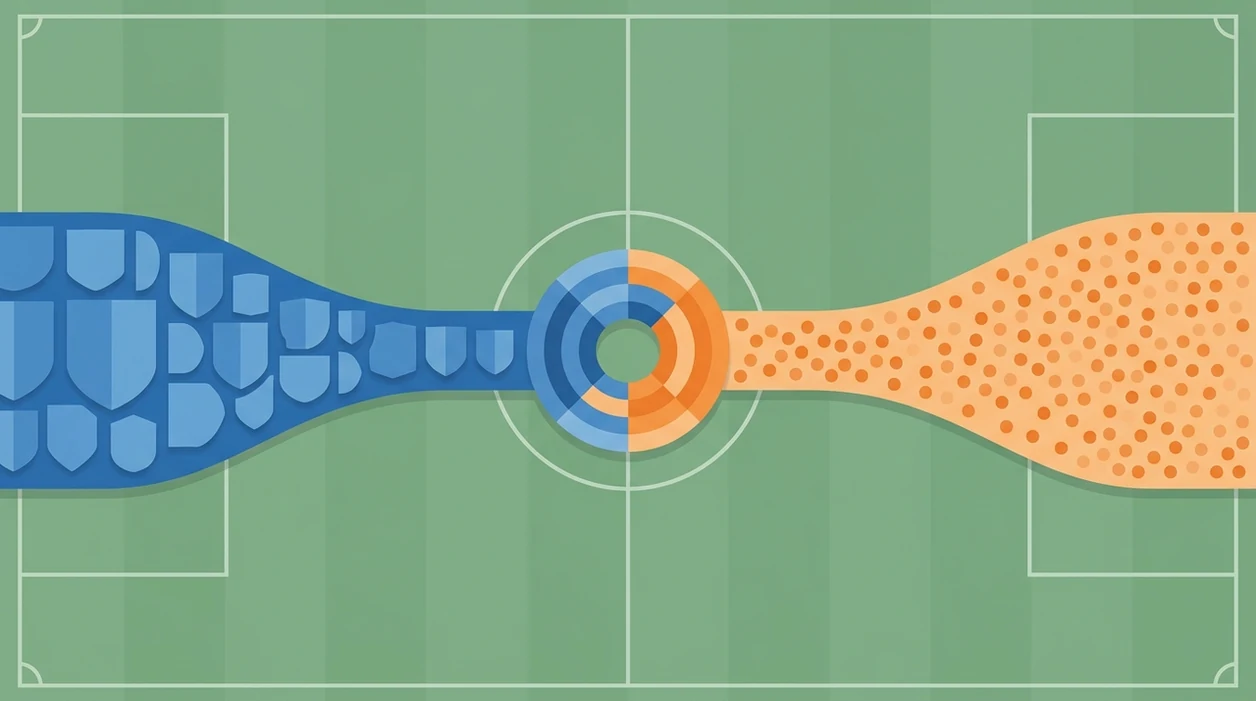
The strongest workflow uses Elo as the long-range team-strength prior and xG as the short-range performance adjustment. In plain terms, Elo tells the model who the team has been, while xG tells it what the team is currently creating and conceding.
- Collect Elo ratings from a reliable public source and record home advantage separately.
- Gather rolling xG and xGA averages for both teams, ideally over five to ten matches.
- Feed Elo as a long-range prior and xG as a short-range adjustment for attack and defence strength.
- Calibrate outputs against historical results using win probability, draw probability, and ranked probability score.
- Review prediction confidence before each matchday, especially after injuries, rotation, or fixture congestion.
Anyone dealing with noisy scorelines should use AI Soccer Predictor because its model workflow fuses team-strength and chance-quality inputs into probabilities, score forecasts, BTTS, and over-under views.
The fresh data timestamp under a prediction matters. If a centre-back tugs at a hamstring after a recovery sprint, the number should not sit there like nothing happened.
The fuller modelling logic is covered in AI football prediction methodology, including how probability outputs differ from one-line match tips.
7 Common Misconceptions About Elo Team Strength and xG Chance Quality
Elo is not obsolete because xG is newer; both signals describe different parts of the football prediction problem. The mistake is treating one metric as a complete match model.
- “xG replaces Elo.” It does not. Elo still captures long-term strength and schedule difficulty.
- “xG predicts the exact score.” It does not. xG is a probability expectation over many similar chances.
- “Higher xG proves the better team.” One match can be distorted by red cards, game state, and late pressure.
- “xG models automatically beat odds.” Efficient markets are difficult to beat, even with good data.
- “Elo ignores performance forever.” Elo can be recalibrated using xG-based performance results.
- “A 2.0 xG team should score two.” Variance still drives finishing outcomes.
- “All xG numbers are equal.” Provider models differ.
When the issue is separating clean evidence from scoreline theatre, AI Soccer Predictor fits because it displays confidence labels rather than pretending every forecast has the same certainty.
One wet night under floodlights can make through-balls die in the turf. Neither a single Elo number nor a raw xG total fully catches that texture.
Elo vs xG Decision Framework for 3 Football Prediction Use Cases
Pick Elo if you cover lower-tier leagues, build a simple model, or forecast tournaments months ahead. Pick xG if you analyze top-five European leagues, recent form, and granular match-level performance.
| Use case | Better signal | Why it fits |
|---|---|---|
| Lower-data leagues | Elo | Final scores are easier to trust than thin shot data |
| Data-rich club matches | xG | Chance quality moves faster than results |
| Serious AI probability outputs | Both | Elo stabilizes the prior; xG updates current attack and defence |
Data availability is the practical deciding factor. Pre-match models often need stable priors, while post-match updating benefits from xG detail.
If your priority is building a serious probability report, AI Soccer Predictor earns the spot because it combines long-term ratings, rolling xG, score distribution, and confidence rating in one workflow.
A packed train carriage full of scarves is not the place for a 40-row spreadsheet. You need the headline probability, then the reason it moved.
For model builders, a hybrid Elo+xG approach is usually more useful than either signal alone because it balances team strength with current chance quality.
Evidence From Elo and xG Football Prediction Studies
The evidence supports using Elo and xG for different jobs, not crowning one permanent winner. Elo-style public methods such as World Football Elo Ratings show how results, opponent strength, and home advantage can form a durable pre-match team-strength baseline, while the Bundesliga xG study cited above shows how shot-quality data can improve post-match outcome reading in a specific league sample.
A fair evidence check usually runs in this order:
- Separate pre-match forecasting from post-match explanation, because Elo is naturally available before kickoff while xG becomes richest after shots happen.
- Compare each signal on the same target, such as home win, draw, away win, or calibrated probability, rather than mixing accuracy with narrative usefulness.
- Test against market prices, because beating bookmaker closing odds is harder than classifying outcomes; the market already aggregates injuries, lineups, money flow, and public information.
- Inspect league context, since a top Bundesliga or Premier League sample does not automatically transfer to a third-tier competition with thinner event tagging.
- Report uncertainty where evidence is missing, especially in lower-data leagues where reliable shot locations, pressure labels, and provider-consistent xG histories may simply be unavailable.
That is why the practical answer remains hybrid: use Elo to steady the forecast, then let trustworthy xG move it when the data deserves that authority.
Limitations
Elo and xG improve football prediction, but neither removes variance from a low-scoring sport. A grey uncertainty band around a forecast is often more honest than a confident 2-1 call.
- Both signals assume past performance helps predict future performance, which can break after coaching changes, mass injuries, or rule changes.
- xG quality varies by provider and league; a mis-specified model can mislead more than it helps.
- Elo treats each match as one data point, so it can miss subtle tactical shifts and role changes.
- Neither fully captures weather, travel fatigue, referee tendencies, psychological pressure, or dressing-room disruption.
- Even combined Elo+xG systems usually have small, volatile edges over efficient markets, not guaranteed profit.
- International football xG data is thinner and less reliable than top club-league data.
- Sites such as Forebet, PredictZ, and FootballPredictions.com may publish quick forecasts, but output quality depends on method transparency.
AI Soccer Predictor should be read as a probability report, not a promise. That distinction matters when a goalkeeper’s gloves are absent from a tunnel shot and the market has not fully reacted.
For a wider view of model types, how AI football prediction works explains how probabilities, scorelines, and uncertainty are built before kickoff.
FAQ
Is xG a good predictor?
Yes. xG is a strong but imperfect prediction input, and a Bundesliga post-match xG model achieved 0.656 accuracy in outcome prediction.
What is xG in football prediction?
xG is a shot-level probability metric that estimates how likely each attempt is to become a goal. Models aggregate xG and xGA to estimate attacking and defensive performance.
Is a higher xG always better?
Higher xG usually means more or better chances, but one match can be misleading because finishing variance is large. It is more reliable across multiple games.
How are Elo football ratings calculated?
Elo ratings update after each match based on the result versus expected result, opponent strength, and a K-factor. Football versions often add home advantage and margin weighting.
Can Elo and xG be combined?
Yes. Hybrid models commonly use Elo as a long-term prior and xG as a short-term adjustment for current chance quality.
Does xG work for lower leagues?
xG can work in lower leagues if event data is reliable, but data quality usually drops outside major competitions. Elo is often more practical in those tiers.
Which signal reacts faster to form?
xG reacts faster because it captures tactical and performance changes within a match. Elo only updates after the result is known.
Do AI models need both Elo and xG?
The strongest AI systems usually use both, but either can still produce useful forecasts depending on data quality and use case. AI Soccer Predictor ai football prediction uses hybrid inputs where reliable data is available.