
AI Football Prediction Methodology: How Models Work and Where They Fail

AI football prediction methodology is the structured process of converting historical match data, team strengths, and contextual variables into probabilistic forecasts, such as a 55% home win, using statistical and machine learning models that are validated against reality. No model guarantees outcomes; responsible methodology focuses on calibration, honest backtesting, and acknowledging structural randomness in football.
> Definition: AI football prediction methodology is the end-to-end framework data scientists use to collect match data, engineer predictive features, train goal-distribution models, validate probability outputs against observed results, and monitor forecast reliability over time.
TL;DR
- AI football models output probabilities, for example 60% home win, not certainties. Methodology quality determines whether those numbers actually match reality.
- Core prediction model inputs include historical results, xG metrics, home advantage, injuries, league-specific patterns, and sometimes bookmaker odds as a benchmark signal.
- Proper model validation requires out-of-sample testing, calibration checks, Brier score measurement, and comparison against simple baselines to avoid overfitting.
What AI Football Prediction Methodology Means
AI football prediction methodology means turning football data into match probabilities, not turning hunches into guaranteed picks. A serious method explains how the model gets from past performance to numbers like 46% home win, 28% draw, and 26% away win.
The important distinction is certainty. Football is a low-scoring sport, so one deflection, red card, or missed sitter can flip a correct read into a wrong result. The model has not seen tomorrow's bounce of the ball.
Methodology matters because fans and analysts need to know whether a forecast is tested or just dressed up. According to a 2015 review in sports forecasting, well-designed models for major football leagues often land around 50 to 75% accuracy on three-way outcomes, depending on league and season source.
Good ai football prediction delivers calibrated probabilities and score ranges, not sure-win claims.
Football Prediction Model Requirements Before Build
A football model methodology starts before the first algorithm runs. You need enough match history, clean context, and a baseline that the model must beat.
The basic dataset should cover multiple seasons and multiple leagues, with final scores, venues, dates, and team identifiers kept consistent. Then comes the awkward stuff: injuries, suspensions, fixture congestion, and travel. A Thursday-Sunday turnaround after a European away match changes the rest disadvantage more than a neat form table admits.
A proper build also needs a benchmark. That might be bookmaker odds, a simple Elo model, or a naive home-win baseline. If the new model cannot beat a basic reference, extra variables are just decoration.
On the technical side, Python, R, scikit-learn, Stan, or another statistical framework is enough. The harder requirement is judgment. You must understand probability, uncertainty, and why a 57% forecast will still lose often.
For input detail, the breakdown of what data AI football predictor uses is the natural companion to this step.
Football Goal Models Behind AI Predictions
AI football prediction models usually work by estimating team strength, projecting goals, then converting possible scorelines into outcome probabilities. That is the mechanism behind most win, draw, BTTS, over-under, and correct-score forecasts.
Team Strength Estimation and Goal Distribution
First, the model estimates attack and defense strength from historical results, xG profile, shot quality, and opponent strength. Raw goals matter, but xG tends to be a cleaner forward signal because it separates chance quality from finishing noise. Studies in top European leagues have found xG-based team metrics outperform raw goals for forecasting future performance. For xG as a forecasting input, cite a concrete study, such as Lucey et al.'s shot-quality work using spatiotemporal football data source.
Next, the model creates goal distributions for each team. A Poisson model is the classic starting point: it estimates how often a team scores 0, 1, 2, or more goals. More advanced systems may use machine learning layers, but they still need a goal expectation underneath.
From Goal Probabilities to Match Outcome Forecasts
The model combines the home and away goal distributions into scorelines, then sums them into home win, draw, away win, over 2.5, and BTTS probabilities. Home advantage and league scoring patterns matter here. Bundesliga matches do not behave exactly like Serie A matches.
Classic Poisson football-model research by Dixon and Coles showed that attack strength, defense strength, home advantage, and time weighting improve score forecasting versus simpler assumptions source. For a deeper mechanism view, read how AI football prediction works.
5 Steps to Use an AI Football Prediction Model Responsibly
Use an AI model as decision support, not as a blind instruction sheet. The right question is not “will this happen?” It is “is this probability fair given the evidence?”
- Check the model's stated inputs and data sources. Look for xG, team strength, injuries, home advantage, and update timing.
- Review calibration reports and historical accuracy. A model claiming 60% should win near 60% over a large sample.
- Compare model probabilities against bookmaker odds as a benchmark. The market is not perfect, but it is hard to beat.
- Assess confidence ratings and uncertainty bands before trusting a pick. A fresh data timestamp matters when the striker absence flashes in the lineup feed.
- Track your own results over 100+ predictions. Small samples lie, especially after one lucky weekend.
Tools like AI Soccer Predictor can help frame a match card, but the useful habit is still the same: compare probability, context, and uncertainty before acting.
Prediction Model Inputs That Drive Forecast Quality
The quality of prediction model inputs sets the ceiling for forecast quality. A clever algorithm cannot rescue stale team news or a flat dataset that treats every match as equal.
- Historical results need time decay. Last month should usually count more than two seasons ago, especially after squad turnover.
- xG and advanced possession metrics reveal chance quality. “They had the ball, but not the chances” is often visible in the numbers.
- Home advantage must be quantified, not assumed. Some clubs turn possession into territory at home; others only pass sideways.
- Injury and suspension data alter tactical shape. One missing full-back can change the BTTS read because the whole back line shifts.
- League and market signals add context. Bundesliga scoring patterns, Serie A tempo, and bookmaker odds can all act as information signals.
For readers comparing model families, the Elo vs xG football prediction split is useful because each signal captures a different kind of team strength.
Model Validation Metrics: Calibration, Backtesting, and Brier Scores
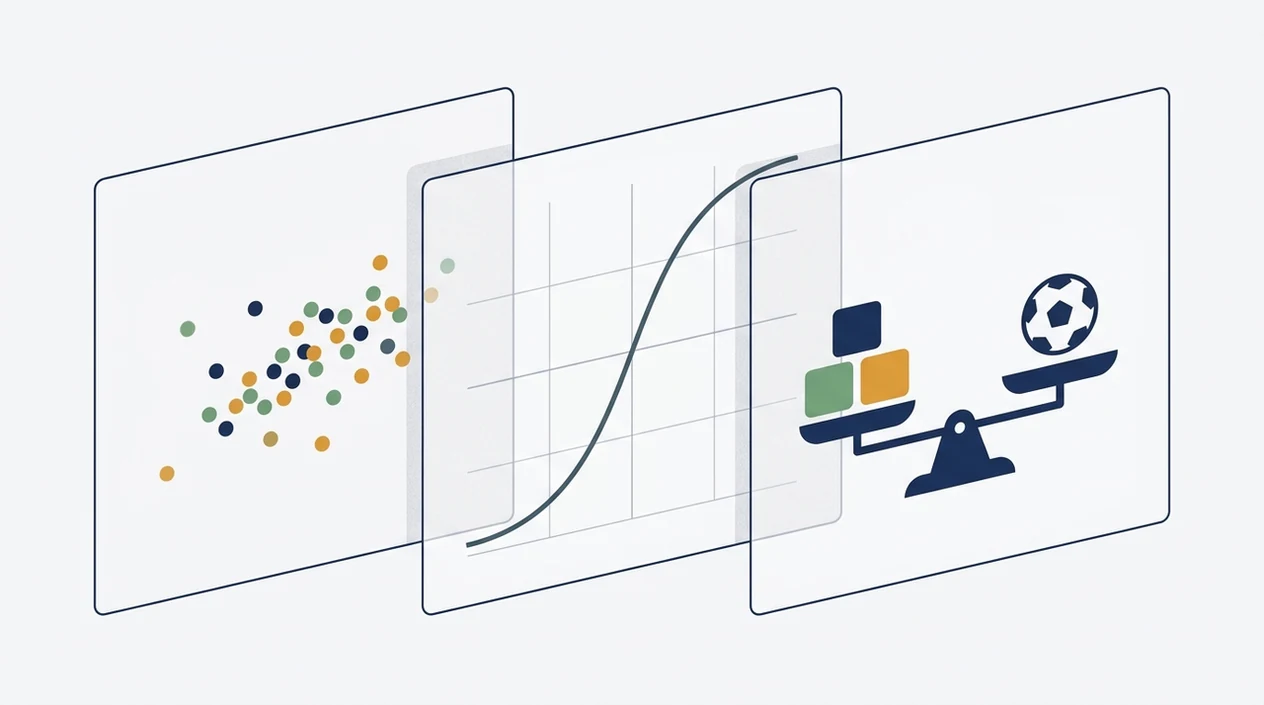
A responsible football model methodology proves reliability with validation metrics, not with a hot run of correct picks. Recent hit rate alone says little unless the test was out-of-sample and compared with a baseline.
For external baselines, compare against named references such as ClubElo ratings, FiveThirtyEight's archived Soccer Power Index where available, and closing bookmaker odds rather than only an internal historical hit rate.
Out-of-Sample Testing vs. Overfitting
Out-of-sample testing means training on past matches, then evaluating on matches the model has not seen. In-sample results are softer. They can reward a model for memorizing noise, like a wet-weather finishing spike that never repeats.
| Metric | What it checks | Why it matters |
|---|---|---|
| Calibration | Whether 60% forecasts win about 60% | Tests probability honesty |
| Brier score | Average squared probability error | Lower is better |
| Backtest return | Historical outcome versus odds | Useful, but easy to overfit |
| Baseline comparison | Model versus simple reference | Prevents fake complexity gains |
Benchmarking Against Bookmaker Odds
Bookmaker odds are a tough benchmark because they aggregate team news, public information, and sharp money. A 2018 study using over 100,000 football matches found bookmaker odds were generally well-calibrated and contained much public information source.
That does not mean markets are unbeatable. It means the model must show work.
Common Mistakes When Applying AI Football Prediction Methodology
The most common mistakes come from treating a prediction model like a results tip sheet instead of a probability system. Good methodology protects against leakage, stale context, and seductive but narrow targets such as exact scores.
- Validate forecasts out of sample, not by last week’s hit rate. A model that went 8 from 10 may still be poorly calibrated if its 70% calls only win half the time across a proper test set.
- Check that training data stops before the match being predicted. Future league position, later injury knowledge, final xG totals, or post-match ratings can sneak into features and make a model look smarter than it is.
- Use bookmaker odds as a benchmark, not as truth. Market prices are informative, but the model still needs independent reasoning and transparent comparison.
- Audit injury and lineup variables before adding them. A striker absence helps only if the feed updates before kickoff and records the same way across leagues.
- Optimize for calibrated probabilities before exact scores. A clean 42% home-win forecast is usually more useful than chasing a fragile 2-1 prediction.
The practical test is simple: if a feature could not have been known before kickoff, it should not be in the forecast.
Common Myths About AI Football Prediction Accuracy
AI football accuracy is often oversold because certainty is easier to market than uncertainty. A serious model talks in ranges, not promises.
| Myth | Reality |
|---|---|
| AI can produce sure bets or 100% certain football picks. | Football has too many low-frequency events: penalties, red cards, goalkeeper errors, and tactical surprises. |
| More complex models always beat simpler calibrated ones. | A clean Poisson or Elo-xG hybrid can outperform an overbuilt model with noisy variables. |
| A high recent hit rate proves a model is profitable. | Without out-of-sample validation, a 15-match run is mostly a confidence trap. |
| Exact-score predictions are more accurate than probability forecasts. | Exact scores are narrower outcomes, so they are naturally harder to hit. |
The reality check is blunt. Published reviews put well-designed three-way football models around 50 to 75% accuracy, and that range still includes plenty of missed single matches.
Fans remember the 2-1 call. Models survive on the boring 1,000-match ledger.
Model Governance: Drift Detection and Retraining Schedules
Model governance keeps a football prediction model from becoming last season's answer to this season's question. Tactics shift, rules change, managers leave, pressing intensity rises, and promoted teams bring unfamiliar profiles.
Drift detection usually means monitoring calibration and Brier score across rolling windows. If 65% home-win predictions start landing at 52%, something has moved. It might be squad turnover, a new league scoring pattern, or a data feed issue. The new simulation batch finishing overnight is only useful if the fresh data timestamp reflects real updates.
Retraining should happen at season boundaries, with mid-season checkpoints when enough new matches exist. Transparent performance reporting is part of the method, not a marketing extra.
This is where responsible methodology separates itself from one-time model dumps. Apps such as AI Soccer Predictor ai football prediction should be judged by update discipline as much as interface polish.
Limitations
Every football prediction model has structural limits. The honest version of AI methodology finds small long-term edges, not quick risk-free profits.
- Football has high variance. Few goals and many random events mean good single-match forecasts miss often.
- Public data misses private context. Locker-room tension, tactical surprises, and late fitness test headlines may not reach the model in time.
- Lineups can break assumptions. A centre-back tugging at a hamstring after a recovery sprint matters, but it may appear only in live context.
- Historical overfitting is common. A model can look sharp in old seasons and fade badly once used live.
- Claims of 80 to 90% stable win rates deserve skepticism. They are rarely backed by audited out-of-sample testing.
- Bookmaker margins erode edges. Betting market efficiency research across sports finds that average bettors and many models struggle to produce long-term positive returns after margins. The same bookmaker-odds calibration evidence cited above is a useful warning here because market prices already contain much public match information source.
- Weather and pitch state distort model priors. Wet turf taking pace off through-balls can lower chance quality quickly.
For model-type tradeoffs, the Poisson vs machine learning football comparison shows why simplicity can still be useful.
FAQ
How do AI football predictions work?
AI football predictions work by converting match data into probabilities for home win, draw, away win, goal totals, and likely scorelines. Most systems estimate team strength, model goal distributions, then validate outputs against real match results.
What data do prediction models use?
Prediction models usually use historical results, xG, shot quality, home advantage, injuries, suspensions, fixture congestion, league patterns, and bookmaker odds. Stronger models also apply recency weighting so old results do not dominate current form.
Can AI guarantee football match results?
No AI model can guarantee football match results. Football has structural randomness from red cards, penalties, injuries, deflections, and low-scoring game states.
What is model calibration?
Model calibration checks whether predicted probabilities match observed outcomes over time. If 60% home-win forecasts only win 48%, the model is poorly calibrated.
Which football prediction site has 90% accuracy?
Stable 90% accuracy on standard three-way football outcomes is not a realistic audited benchmark for most public models. Published sports forecasting reviews more commonly place well-designed models around 50 to 75%, depending on league, season, and market.
Does a complex football model always predict better?
No, a complex football model does not always predict better. Simpler calibrated models can beat over-engineered systems when the extra variables add noise instead of signal.
How accurate are AI football models?
AI football models often report three-way outcome accuracy somewhere around 50 to 75% when well designed and tested, according to sports forecasting research. Accuracy varies by league quality, data depth, lineup certainty, and validation method.
What is a Brier score in football predictions?
A Brier score is a probability-error metric that measures how close forecast probabilities are to actual outcomes. Lower Brier scores mean the model's probabilities are more accurate on average.
Can AI models beat bookmaker odds?
AI models can sometimes identify small pricing gaps, but bookmaker odds are generally well-calibrated and difficult to beat consistently. AI Soccer Predictor and similar tools are better treated as probability aids than proof of an edge.