
How AI Football Prediction Works: From Raw Data to Pre-Match Probabilities

How AI football prediction works starts with collecting historical match data, engineering features like xG and form metrics, training a machine learning model on thousands of past results, and outputting calibrated probabilities for each upcoming fixture. The process is repeatable, data-driven, and transparent, but it estimates likelihood, never certainty.
> Definition: AI football prediction is the process of using machine learning models trained on historical match data to generate pre-match probabilities for outcomes such as home win, draw, away win, and goal totals.
TL;DR
- AI match models ingest thousands of historical results, player stats, xG, and contextual factors to learn outcome patterns.
- The football prediction process has five stages: data collection, cleaning, feature engineering, model training, and probability output.
- Even strong models classify home/draw/away outcomes only about 52 to 60% of the time in published multi-league research source; football’s randomness sets a hard ceiling.
- Calibration ensures a stated 60% probability actually wins about 60% of the time in practice.
- Last-minute injuries, tactical shifts, and noisy data remain blind spots no public AI model fully solves.
What AI Football Prediction Means (Definition)
AI football prediction is the process of using machine learning models trained on historical match data to generate pre-match probabilities for outcomes such as home win, draw, away win, and goal totals.
That matters because prediction is not the same as score guessing. A serious model does not say “2-1” as if it has seen the match. It builds a probability map: home win 46%, draw 27%, away win 27%, over 2.5 goals 51%, both teams to score 54%.
Good AI football predictions deliver calibrated match probabilities, not guaranteed scores. The useful part is the range. If a scoreline grid on a laptop shows green percentage blocks beside 2-1, the 2-1 is only one branch of the match tree.
How AI Football Prediction Works
AI football prediction works by turning messy football data into calibrated pre-match probability. In plain terms, the model converts what is known before kickoff into percentage estimates for outcomes such as home win, draw, away win, goals, or both teams to score.
The pipeline is simple in shape, even when the data is awkward in practice:
- Collect raw fixtures, results, team statistics, player data, xG, venues, dates, and match context from reliable feeds.
- Clean the records by fixing duplicates, postponed matches, missing values, team-name mismatches, and competition noise.
- Build features that translate football context into machine-readable signals, such as rolling xG, rest days, home advantage, opponent strength, and injury flags.
- Train the model on historical examples so it learns relationships between pre-match conditions and past outcomes, not secret knowledge of future matches.
- Calibrate the output so a 60% forecast behaves like a real 60% event over many similar fixtures.
That final number is a probability forecast, not a guaranteed score prediction. A model can rank 1-1 or 2-1 as plausible, but it cannot know which bounce, card, or deflection will decide the match.
Requirements Before Building an AI Match Model
A usable AI match model needs clean historical data, relevant team and player statistics, contextual inputs, a supervised learning framework, and a proper validation split before it predicts one fixture.
Start with multiple seasons across multiple leagues. One league can teach a model bad habits, especially if that era had unusual scoring patterns or a dominant club skewing results. Then add team and player feeds: xG, shot quality, shots per 90, passes into the box, pressing data, set-piece threat, and goalkeeper performance.
Context matters too. Injuries, home/away splits, schedule congestion, travel, and the Thursday-Sunday turnaround after a European away match all change the base rate. The awkward bit is timing. The team sheet drops about an hour before kickoff, and one missing full-back can change the BTTS read.
Most builders use Python with scikit-learn, XGBoost, or a similar framework. The final requirement is a holdout season or back-test, which stops the model from congratulating itself on matches it has already memorised.
Step 1 — Collect and Clean Historical Match Data
Step 1 is gathering match data from APIs, stat providers, and open datasets, then cleaning it until each fixture represents one reliable modelling record.
Raw football data is messier than it looks. Postponed matches create date problems. Cup lineups sneak into league-only files. Duplicate fixtures appear when a provider updates kickoff times. Missing xG values need rules, not guesses. If a model treats “unknown” as “zero,” it will learn nonsense.
The clean file should include final score, venue, date, team names, pre-match table context, and available performance stats. You then remove irrelevant columns that add noise without signal. More rows are not automatically better.
In one study across 11 European leagues, gradient boosting and related methods classified home/draw/away outcomes at roughly 52 to 60% accuracy, depending on league and feature set, using cleaned datasets source. That range is useful, but it is not magic.
The practical test is dull but decisive: spot-check five fixtures by hand before training and make sure dates, venues, teams, and xG values match the original feed.
Step 2 — Engineer Features That Drive Prediction Quality
Feature engineering turns raw football data into variables the model can actually learn from, and it is often the biggest gap between amateur and expert prediction work.
A raw shot count says something. A rolling home xG average over the last five league matches says more. Features can include shots per 90, xG for and against, rest days, Elo-style team strength, opponent defensive rating, travel distance, and strength-of-schedule adjustments. The better question is not “how many stats?” It is “which stats describe chance quality before kickoff?”
Form windows help, but they need care. Last five matches can catch tactical change. Last ten matches reduces noise. Elo ratings smooth team strength across longer stretches. For a deeper split of rating signals, the Elo vs xG football prediction comparison is the useful fork in the road.
I’ve seen models improve more from adding “days since last match” than from adding twenty decorative possession columns. They had the ball, but not the chances.
Step 3 — Train and Validate the AI Prediction Model
Step 3 trains a supervised machine learning model on labelled past outcomes, then tests whether it predicts unseen matches rather than remembered ones.
The target is usually home win, draw, away win, over/under goals, or BTTS. Common algorithms include gradient boosting, random forest, logistic regression, neural networks, and Poisson hybrids. In plain terms, the model learns which pre-match patterns tended to lead to each outcome.
Validation is where the vanity stops. Cross-validation checks stability across different samples. Back-testing against held-out seasons checks whether the model survives real chronological drift. A peer-reviewed English Premier League model from 2000 to 2017 achieved a Brier score of 0.20 and log loss of 0.77, performing around bookmaker level in that study source.
For football prediction, back-testing on future seasons is often more honest than random splits because squads, managers, and styles change over time.
Wet turf under floodlights can take pace off through-balls. The spreadsheet only sees that if someone feeds it weather.
Step 4 — Calibrate Probabilities and Generate Pre-Match Forecasts
Calibration means a model’s stated probabilities should match real-world frequency; if it says 60%, that kind of event should happen about 60% of the time.
Many models output raw scores first. Those scores are not automatically trustworthy probabilities. Platt scaling and isotonic regression are common calibration methods that reshape model outputs against validation data. The aim is simple: make confidence mean something.
Final forecasts usually show home win %, draw %, away win %, over/under lines, BTTS, and likely scoreline ranges. A 1-1 at 11% and a 2-1 at 9% are close neighbours, not promises.
Uncalibrated models can be confidently wrong. That is worse than being cautious. A model confidence badge turning amber after fresh data is not cosmetic; it tells you the forecast is less settled than the headline number suggests.
End-to-End Football Prediction Pipeline
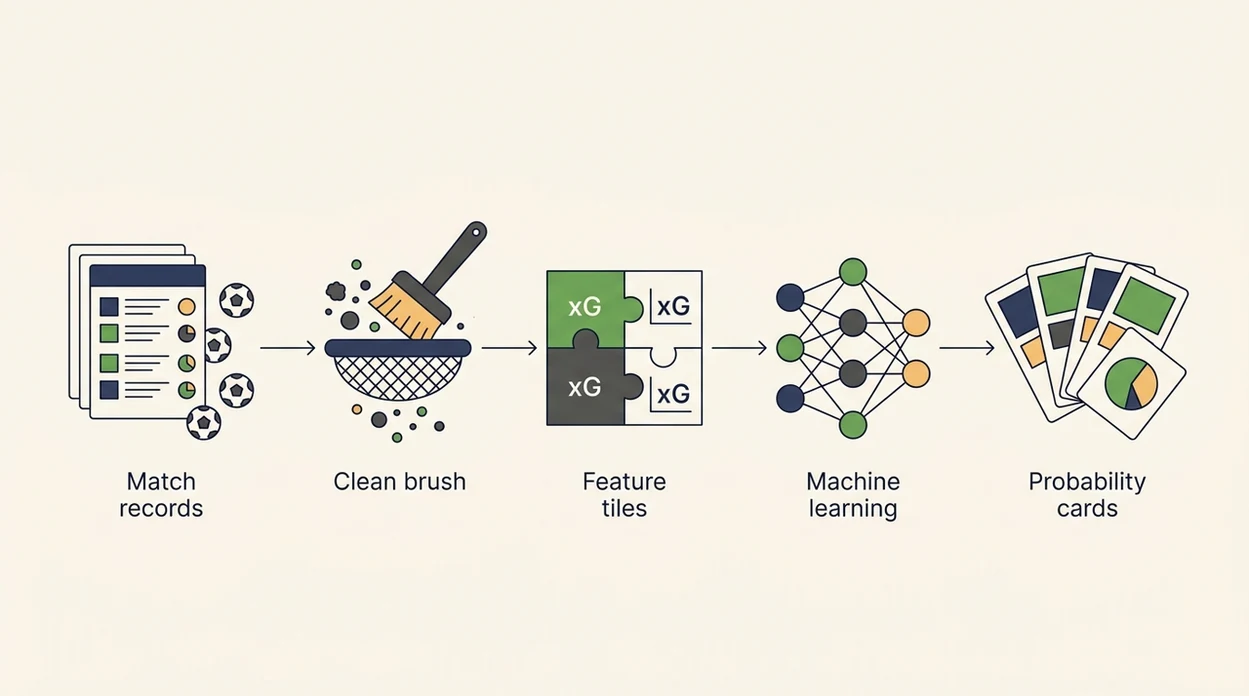
An end-to-end football prediction pipeline follows the same order every matchday: ingest data, clean it, engineer features, train or update the model, calibrate probabilities, and publish the forecast.
The mechanism is repeatable. Fresh results update team strength and form windows. Injury and lineup feeds enter late as feature injections, not as gossip. If an academy defender is named on the teamsheet, the model should adjust defensive stability rather than pretend the club is unchanged.
Tracking and event data can help models recognise tactical structure, pressing behaviour, and positional patterns, but those tasks are narrower than predicting final scores. Public football-data research shows why: richer tracking inputs improve what a model can observe, while match results still depend on finishing, cards, deflections, and game state source.
That pipeline separates serious AI match models from chatbot guesses. Tools like AI Soccer Predictor fit this category when they show probabilities, confidence ratings, and model factors instead of a single unsupported score.
How to Use AI Football Predictions Before a Match
Use AI football predictions as one evidence layer before kickoff, not as a replacement for watching team news, market movement, or match context.
- Check the AI probability output for the fixture, including home/draw/away, BTTS, over/under, and score forecast.
- Compare the probability with your own read or the implied probability in bookmaker odds.
- Review late context the model may miss, such as injuries, weather, rotation, or a surprise tactical shape.
- Assess the confidence rating and look for sample-size caveats, especially in cups or lower leagues.
- Form your opinion from the combined evidence, not from the biggest percentage alone.
For most fans, probability comparison is more useful than asking for one correct score because it keeps uncertainty visible. If you want a practical match-card format, an AI football predictor can show the forecast without burying the decision in raw tables.
Halftime coffee cooling beside fixtures is familiar. Pre-kickoff, you want the cleaner read.
Common Mistakes in AI Football Prediction Models
The most common AI football prediction mistakes are overfitting, adding noisy data, trusting short hot streaks, and ignoring how much information closing bookmaker odds already contain.
Overfitting happens when a model learns one league, one period, or one tactical era too closely. It may look sharp in a back-test, then fail when pressing styles, squad depth, or substitution rules shift. More data can also hurt if it mixes competitions with different incentives. A second-leg cup tie is not the same as a mid-table league match.
Hot streaks are another trap. A model that lands six correct outcomes in a row has not proven permanent edge. Football clusters luck.
Research comparing football forecasting models with betting markets has repeatedly found that statistical models can approach bookmaker odds, but beating efficient closing prices after margin is much harder source. The full model-design problem sits inside machine learning football prediction, where validation matters more than a good-looking weekend.
At-a-Glance: 5 Facts About How AI Predicts Football
- Fact 1: AI football models train on thousands of historical matches to learn links between pre-match conditions and outcomes.
- Fact 2: Gradient boosting and random forests are among the most common algorithms because they handle mixed football features well.
- Fact 3: Exact home/draw/away accuracy usually tops out around 52 to 60% in published multi-league studies.
- Fact 4: Calibration turns raw model scores into probabilities that can be checked against real match frequency.
- Fact 5: Real-time injury and lineup data remains the biggest gap in many public models.
A finger smudge across a probability chart is a small thing, but it says a lot. People use these numbers quickly. The numbers need to be plain.
Myths About How AI Football Prediction Works
AI does not see the future of a football match. It estimates probabilities from past patterns, current team strength, and known context.
The second myth is that more data always equals better prediction. Bad injury feeds, stale lineups, and irrelevant possession stats can make the signal worse. A model needs useful data, not just a larger folder.
Another myth says a model that beat bookmakers once will keep winning. Markets adapt, team styles drift, and closing odds already reflect huge amounts of expert information. A one-month edge can vanish by winter.
The final myth is that any chatbot can predict precise scores on demand. Serious scoreline models use distributions, often Poisson-based or machine-learning based, to rank outcomes. The Poisson vs machine learning football debate is really about how to represent goal uncertainty, not how to eliminate it.
AI Soccer Predictor ai football prediction should be judged the same way: by probability quality, not by confident score theatre.
Limitations
AI football prediction has real limits because football is low-scoring, tactical, and noisy. A single red card, deflection, or keeper mistake can break a sensible pre-match forecast.
- Football’s low-scoring structure caps predictive accuracy; a stronger side can create better chances and still lose 1-0.
- Public models often lack real-time dressing-room, tactical, and late injury intelligence.
- Academic accuracy figures can look cleaner than live matchday conditions, where lineups and markets move fast.
- Models trained on one league or era may not transfer well without re-training.
- Overreliance on AI for gambling ignores odds value, bankroll control, bookmaker margin, and personal financial risk.
- Model performance drifts as rules, squad composition, pressing intensity, and substitution patterns evolve.
- Correct score prediction is especially fragile because many scorelines sit close together in probability.
A centre-back tugging at a hamstring after a recovery sprint is context, not drama. The model may not see it until the damage is already in the data.
Apps such as AI Soccer Predictor can help organise evidence, but they cannot remove variance.
FAQ
Can AI predict football accurately?
AI can predict football usefully, but not perfectly. Strong models often classify home/draw/away outcomes around 52 to 60% of the time.
How does an AI football predictor work?
An AI football predictor collects data, cleans it, engineers features, trains a model, and outputs calibrated probabilities. The output is a likelihood estimate, not certainty.
What data do AI football models use?
AI football models use historical results, xG, shots, player stats, injuries, home/away splits, and schedule congestion. Better models also include lineup and rest data.
Is AI better than bookmaker odds?
AI models can approach bookmaker odds, but they rarely outperform closing odds consistently after margins. Closing markets already contain expert and public information.
What is xG in football prediction?
Expected goals, or xG, estimates the probability that a shot becomes a goal. It helps measure shot quality better than raw shot count.
Can AI predict exact football scores?
AI can rank likely scorelines, but it cannot guarantee exact scores. Score forecasts are probability distributions.
Does more data improve AI football predictions?
More data helps only when it is relevant and clean. Noisy or mismatched data can reduce prediction quality.
How often are AI football predictions wrong?
Even strong AI models are wrong on roughly 40 to 48% of individual home/draw/away outcomes. Football variance makes errors unavoidable.
Can I use AI to bet on football?
Fans can use AI probabilities to inform betting decisions, but financial risk remains. Bookmaker margins and poor bankroll control can erase any perceived edge.