
What Data AI Football Predictor Uses for Match Forecasts

what data AI football predictor uses spans six core categories: historical match results, expected goals (xG), team news and lineups, contextual factors such as weather and travel, schedule congestion, and market signals. Models clean and weight these inputs into features for Elo-style ratings, Poisson goal distributions, and machine-learning classifiers that output probabilities rather than guarantees.
> An AI football predictor is a system that ingests structured match, player, and contextual data to generate probabilistic forecasts for outcomes such as win/draw/loss, correct score, and total goals.
- AI models combine historical events, xG, player availability, and contextual factors into feature sets.
- Data is transformed into rolling averages, opponent-adjusted ratings, and per-possession metrics before modeling.
- Even rich data cannot account for red cards, freak injuries, or one-off tactical surprises.
6 Core Football Prediction Data Categories
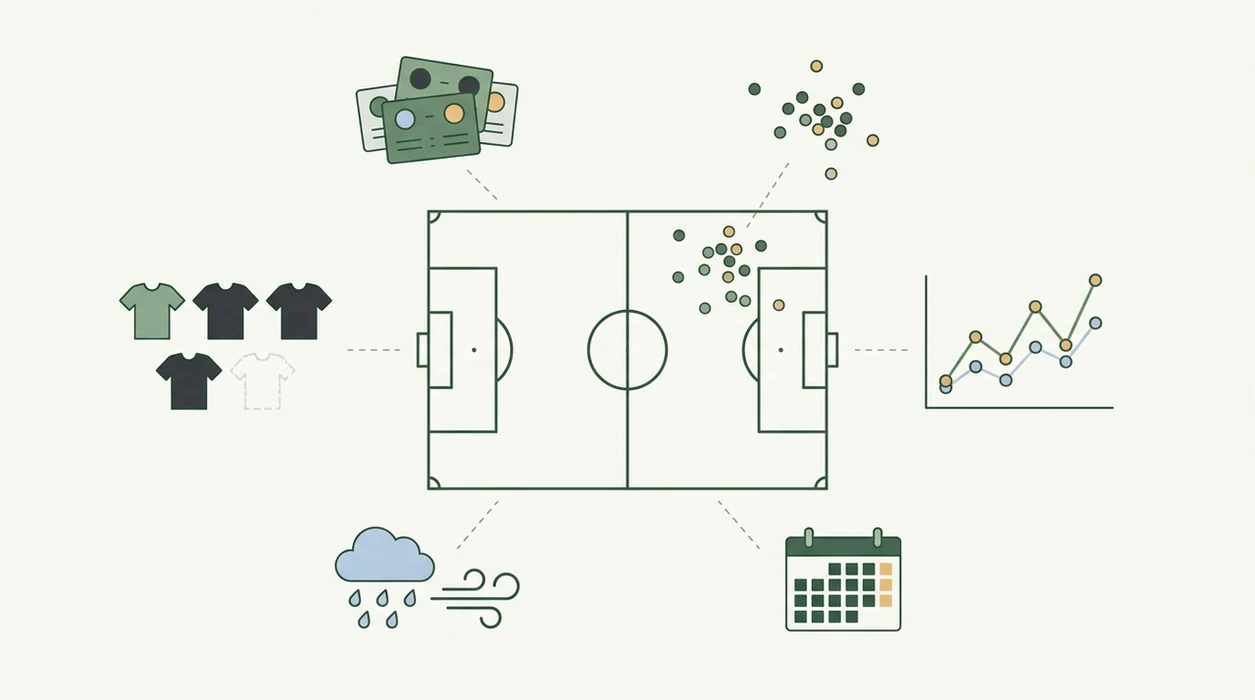
The six data groups below are the minimum useful input set for AI football prediction. Historical results create the baseline, while xG, availability, context, schedule load, and market movement explain why today’s match may differ from that baseline.
- Historical results set the baseline: wins, draws, goals, cards, corners, possession, and home-away splits.
- xG and advanced metrics measure shot quality, chance volume, expected assists, and territory gained.
- Team news covers injuries, suspensions, rotation risk, transfers, and the confirmed team sheet about an hour before kickoff.
- Contextual factors include weather, pitch speed, derby pressure, travel, altitude, and stadium familiarity.
- Schedule data tracks rest disadvantage, midweek travel, and the awkward Thursday-Sunday turnaround after Europe.
- Market signals can act as a comparison layer, not the main engine.
These categories are fused into unified feature vectors, not kept in separate drawers. That matters. A missing left-back changes press resistance, which changes the BTTS read. Data quality also varies sharply by league tier; top divisions get richer event feeds than small cup ties on a muddy pitch.
Where AI Football Prediction Data Comes From
AI football prediction data comes from a mix of live match feeds, official team information, contextual services, and market records. The model then adds its own calculations on top, such as ratings, form weights, and goal probabilities.
- Start with event feeds that log shots, passes, cards, substitutions, corners, pressure sequences, and xG-style tags where available. These are the backbone for live and post-match updates.
- Add team and player inputs from lineups, injuries, suspensions, rotation notes, and confirmed squads. Some of this changes close to kickoff; deeper availability records may settle only after clubs or providers verify them.
- Refresh context with weather, venue, travel, rest days, and pitch notes. Weather and lineups can move live, while final event corrections, player minutes, and some advanced metrics often update after the match.
- Compare market movement as an external signal, while keeping it separate from model-owned calculations. Odds are third-party inputs; the probability engine should not simply copy them.
- Adjust for coverage depth because major leagues usually have richer cameras, tagging, and provider attention than small competitions. AI Soccer Predictor depends on visible, timely input refreshes, especially when team news or late conditions change the read.
How AI Football Prediction Models Process Raw Data
AI football prediction works by turning messy match data into comparable features, then feeding those features through rating, goal, and classification models. Raw feeds are cleaned first: duplicate events are removed, conflicting xG values are reconciled, and missing player records are either estimated or flagged.
Feature Engineering and Data Transformation
Feature engineering turns football prediction data into model-ready signals. Common examples include rolling xG averages, opponent-adjusted ratings, set-piece threat per match, and per-possession chance creation. For a deeper model map, the AI football prediction methodology explains how these inputs become repeatable forecasts.
A fresh data timestamp matters. If the model last updated before the squad list was pinned for travel, I treat the output carefully.
Model Layers From Elo to Machine Learning
Most systems combine three layers: Elo-style strength ratings, Poisson or goal distribution models, and machine-learning classifiers. Elo handles team strength. Poisson estimates scoreline frequency. Classifiers detect non-linear patterns across xG profile, rest disadvantage, and lineup squeeze. Good AI football predictions deliver probability ranges, not certainty theatre.
Before You Read Football Prediction Data
Before reading football prediction data, check whether the match details and data freshness are reliable. A strong-looking model page can mislead if it is built on stale team news, the wrong kickoff window, or a thin lower-tier feed.
- Confirm the fixture details before judging any input: match date, competition, venue, and kickoff time. Cup rotations and neutral grounds can change the whole read.
- Check the refresh timestamp on the prediction page, especially close to team-sheet release. If the feed updated before a late injury or travel squad announcement, the probability may be behind the match.
- Separate confirmed news from noise by treating official lineups, suspensions, and club updates differently from rumors, projected XIs, and social-media “expected” teams.
- Use league context when weighing the data. Premier League event feeds are usually deeper than lower-tier or small-cup feeds, where xG, pressure, and player-level records can be patchy.
- Treat odds movement as a prompt, not proof. A price shift may point to new information, but it still needs checking against team news, market liquidity, and timing.
5 Steps to Read AI Model Inputs on a Prediction Page
Use the inputs before you use the forecast. A 58% home win can mean very different things if it comes from strong shot quality or just a soft opponent run.
- Check the team form window, usually the last 5-10 matches, with separate home and away splits.
- Review xG and shot quality, not only goals scored; ask whether chances were repeatable.
- Scan lineups, injuries, and suspensions when team news drops, because one absent centre-back can stretch the back line.
- Note contextual flags such as derby status, rain, travel, or midweek congestion.
- Compare the AI probability output against your own read of the data before trusting the score forecast.
Tools like AI Soccer Predictor can be useful here when the page shows inputs beside probabilities rather than hiding the model behind a single scoreline.
Expected Goals (xG) and Advanced Metrics as AI Model Inputs
Expected goals, or xG, estimates the probability that a shot becomes a goal based on location, angle, body part, assist type, and pressure. Expected assists, or xA, estimates the chance quality created by a pass before the shot.
xG matters because it separates shot quality from shot volume. Ten blocked shots from poor angles do not equal three central chances. A 2018 study across 10 European leagues found that xG models explained 59-75% of team goal variation and beat raw shot counts as a predictor source.
Still, lower-league xG can be thin. Camera angles miss details. Event tags arrive late. For readers comparing models, Elo vs xG football prediction is often clearer than judging teams by the table alone.
Team News, Injuries, and Lineup Data in Prediction Models
Do injuries change AI football predictions? Yes, player availability is one of the highest-impact AI model inputs because it changes team structure, not just individual quality.
Injuries, suspensions, rotations, and mid-window transfers are encoded as structured features. A 2017 study using more than 8,000 English Premier League matches found that adding player availability improved forecasting accuracy versus team-only models source.
Models should not treat absence as a binary switch. Missing a holding midfielder hurts build-up security differently from missing a winger. I also watch warm-ups; a centre-back tugging at a hamstring after a recovery sprint is context, not drama.
Home Advantage, Weather, and Schedule Congestion Contextual Data
Contextual data covers match conditions that change how teams turn possession into territory. It includes home advantage, weather, pitch condition, travel distance, rest days, and fixture congestion.
Professional football research has put home wins around 46%, away wins around 28%, and draws around 26% across major European leagues source. That home tilt is not just crowd noise. It reflects travel, routine, referee pressure, and pitch familiarity.
Rain matters too. Wet turf under floodlights can take pace off through-balls, which lowers clean transition chances and may pull total-goals projections down. Weather and pitch are not extras; they are structured inputs. Schedule load works the same way, especially after a European away match and a short league turnaround.
4 Common Mistakes When Interpreting Football Prediction Data
The first mistake is assuming league tables drive predictions. Tables show outcomes, but models care about how those outcomes were produced.
The second mistake is treating bookmaker odds as the primary AI input. Serious models may compare against football prediction markets, but they should not simply copy them.
Third, many readers forget that AI inputs are dynamic. Form windows, injury return dates, and fixture congestion recalculate before each match. The model you saw at lunch may not match the one after team news.
Last, a high-probability forecast is not a guarantee. A 65% home win still loses often enough to make anyone on the train home mutter, “they had the ball, but not the chances.”
Limitations
AI football prediction is useful, but it has hard edges.
- Red cards, freak injuries, deflections, and goalkeeper errors are low-frequency events that historical data cannot reliably predict.
- Lower-league and niche-competition data is often weak, especially for xG, pressing data, and player-level availability.
- Models can overfit to a team’s old style and lag behind a coaching change or tactical reset.
- Many marketed AI predictors are simple statistical models with limited inputs and inflated accuracy claims.
- Richer data and more complex models increase computational cost, so not every tool uses the full input set.
- A machine-learning study on English Premier League forecasting found that richer feature sets improved predictive performance, but gains remained incremental rather than result-guaranteeing source.
- Market movement can reflect information the model has not processed yet, especially late injury leaks.
Small gaps get loud.
For more technical readers, machine learning football prediction explains why more variables can help while also raising overfitting risk.
FAQ
What data is used for football predictions?
Football predictions use match events, historical results, xG, team news, injuries, suspensions, weather, schedule congestion, and home-away context. Strong models turn that football prediction data into probability estimates.
Does xG matter more than goals scored?
xG often carries more predictive value than raw goals because it measures chance quality. Goals still matter, but they can be noisy in small samples.
Do injuries change AI predictions?
Yes, injuries change AI predictions because player availability affects shape, pressing, buildup, and finishing quality. Research on more than 8,000 EPL matches found improved accuracy when availability was included.
Is there an app that predicts football?
Yes, apps and sites such as Football AI, NerdyTips, and AI Soccer Predictor provide football forecasts. AI Soccer Predictor ai football prediction is web-based and focuses on probabilities, score forecasts, and confidence ratings.
What type of AI is used for prediction?
Common approaches include Poisson goal models, Elo ratings, gradient-boosted trees, and neural networks. Many systems combine several methods rather than relying on one model.
Does weather affect match predictions?
Yes, weather affects match predictions when it changes tempo, passing speed, shot quality, or total-goals expectation. Heavy rain and poor pitch condition can reduce clean chance creation.
How accurate are AI football predictors?
Accuracy varies by model quality, league data depth, and team-news freshness. No AI football predictor guarantees the result of an individual match.
Are bookmaker odds an AI input?
Bookmaker odds can be an optional reference input or benchmark. Serious models usually rely first on AI model inputs such as xG and team news, then compare probabilities against the market.