
Football Prediction Glossary: AI Forecast and Probability Terms Defined

This football prediction glossary defines every key term you encounter on AI forecast sites, from xG and BTTS to calibration and confidence ratings, so you can interpret match probabilities correctly. Each entry explains what the term measures, how AI models use it, and why it matters for understanding score forecasts.
> Definition: A football prediction glossary is a structured reference of terminology used in AI-driven match forecasting, covering probability metrics, market types, and statistical indicators that describe how likely specific football outcomes are.
TL;DR
- Covers 20+ core prediction terms including xG, BTTS, 1X2, over/under, calibration, and confidence
- Each term links to how AI models generate probabilities rather than just defining betting jargon
- Even the best statistical models correctly predict exact outcomes only 50–60% of the time in top leagues
How a Football Prediction Glossary Works
Quick answer: A football prediction glossary explains the language of probability, not certainty. Terms like 1X2, BTTS, xG, and confidence rating describe how likely an outcome is, not what must happen.
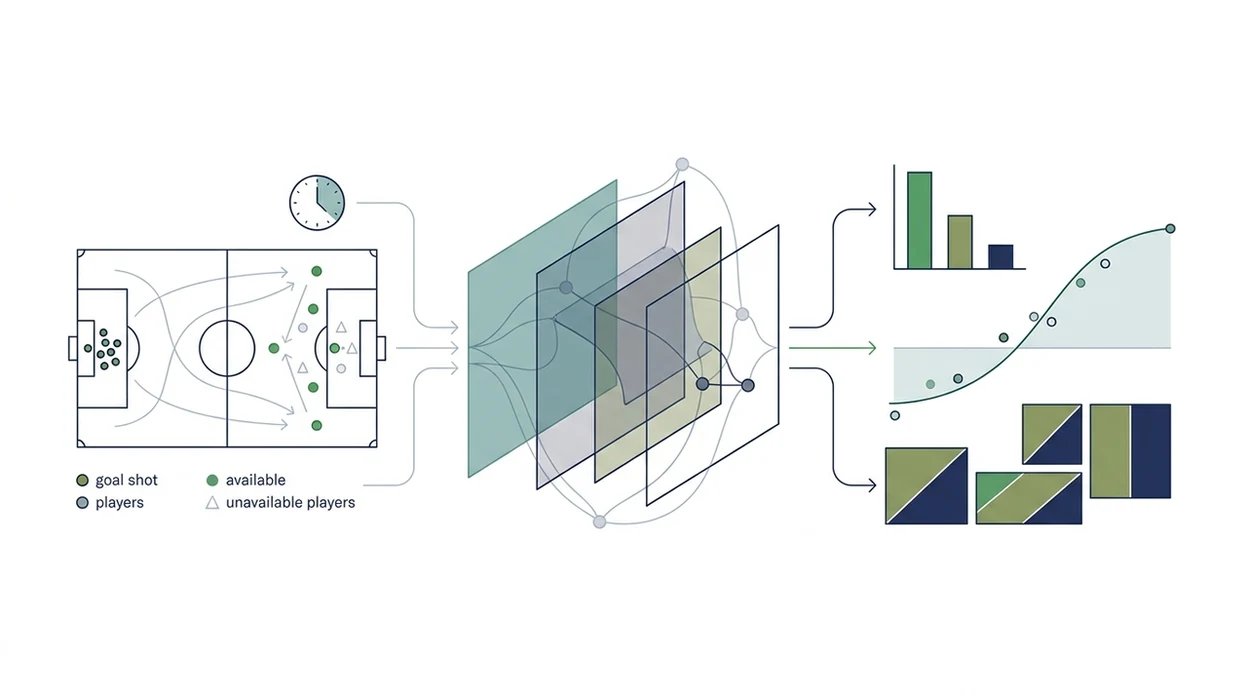
AI forecast models convert historical match data into probabilities. The input layer usually includes shots, possession, xG profile, home tilt, set-piece threat, rest disadvantage, and lineup availability. The output layer turns that into win, draw, loss, goal-line, or scoreline probabilities. For a deeper base layer, football probability explains how those percentages should be read.
A glossary bridges the gap between raw model output and fan-readable forecasts. When a screen shows green percentage blocks beside 2-1, the glossary tells you whether that is a likely score, a model mode, or a low-probability exact result.
Use it this way:
- Check the term before reading the prediction.
- Compare the percentage with the market or scoreline.
- Treat the forecast as a range, not a promise.
Even strong football forecasting models often land in the 50–60% range for three-way home/draw/away outcomes, depending on league, sample, and evaluation method; for example, benchmark football prediction research commonly reports modest gains rather than near-certain accuracy (https://doi.org/10.1016/j.ijforecast.2018.01.003).
How to Use a Football Prediction Glossary
Use a football prediction glossary as a reading tool before you trust any percentage on the screen. It helps you identify what the model is actually estimating, then judge whether the number is meaningful in context.
- Start with the market term before the forecast percentage. A 58% label means different things if it belongs to 1X2, BTTS, over 2.5 goals, or a confidence rating.
- Identify whether the term describes an outcome, a goal threshold, model confidence, or model quality. Win probability, xG, calibration, and drift answer different questions.
- Compare the displayed percentage with the definition and any stated limitation. If a correct-score line is 12%, that may be the top score forecast while still being unlikely in absolute terms.
- Read AI Soccer Predictor ai football prediction labels as probability ranges, not promises. Green blocks, stars, or confidence tags should guide interpretation, not replace judgement.
- Recheck lineup, injury, and weather context before trusting pre-match numbers. A late striker absence or heavy rain can shift goal markets faster than old head-to-head records.
Match Outcome Prediction Terms: 1X2, DNB, and Double Chance
Definition: Match outcome prediction terms classify the possible result of a football match into home win, draw, away win, or protected combinations of those outcomes.
1X2 Market Probabilities
1X2 means 1 = home win, X = draw, and 2 = away win. AI models assign a percentage to each result, often after estimating expected goals for both teams. A line such as 45% home, 28% draw, 27% away means the home side has the highest probability, not a guaranteed edge.
Regional labels vary. Some platforms call it match result, full-time result, or three-way result. Same idea, different wrapper.
DNB and Double Chance Definitions
DNB means Draw No Bet. If the match finishes level, the selection is void rather than counted as a win or loss in that market. Models often flag DNB when one team has a narrow edge but the draw probability is still heavy.
Double Chance combines outcomes: 1X covers home win or draw, X2 covers draw or away win, and 12 covers either team to win. Good ai football prediction tools deliver probability ranges and model factors, not guaranteed picks or “sure win” claims.
xG Meaning in Football Prediction Models
Definition: xG, or expected goals, is a statistical estimate of how many goals a team or player would be expected to score from the quality of chances created.
Descriptive xG vs Predictive xG
Descriptive xG looks backward. It says what a team’s chances were worth after the match. Predictive xG looks forward by using past chance quality, shot volume, opponent strength, and tactical context to estimate future goal expectancy.
xG is not a literal score prediction. A team can post 1.8 xG and still lose 1-0 because football has variance. The train-home version is simple: they had the ball, but not the chances.
Different providers use different shot features. Opta, StatsBomb, Wyscout, and club-built models may weight location, body part, assist type, pressure, goalkeeper position, and defender position differently, so 1.5 xG from one provider is not always equal to 1.5 xG from another.
Research on football forecasting has found that expected-goals-style shot quality features can improve prediction compared with goals and basic match statistics alone; see, for example, The American Statistician's expected goals modelling overview (https://doi.org/10.1080/00031305.2018.1437996) and broader football forecasting work in the International Journal of Forecasting (https://doi.org/10.1016/j.ijforecast.2018.01.003). The xG vs traditional stats debate matters because goals alone hide chance quality.
BTTS Meaning, Over/Under, and Goal-Line Prediction Terms
Definition: Goal-line prediction terms describe whether teams are expected to score and whether total goals are likely to cross a stated threshold.
BTTS and GG/NG Explained
BTTS means Both Teams To Score. It asks whether each team will score at least one goal. A BTTS forecast at 58% means the model sees that outcome as more likely than not, but it still fails often.
GG/NG is a regional label for the same idea. GG usually means both teams score. NG means at least one team does not score. The BTTS meaning is commonly misunderstood because people read “BTTS” as “both teams will score.” It is only a probability category.
A missing full-back on the team sheet can move this number. One weak flank changes crossing volume fast.
Over/Under Goals Thresholds
Over/Under 2.5 goals is a total-goals threshold. Over 2.5 means three or more goals. Under 2.5 means zero, one, or two goals.
AI models usually calculate these probabilities from expected goal totals, scoring rates, defensive allowance, tempo, and game-state patterns.
Statistical Model and AI Prediction Terms
- Win probability is the percentage likelihood assigned to each 1X2 outcome, such as 46% home win, 29% draw, and 25% away win.
- Confidence rating is the model’s self-assessed certainty level, usually based on probability gap, data quality, lineup stability, and market agreement.
- Score forecast is the most likely scoreline generated from goal expectancy distributions, not a claim that the match will finish that way.
- Elo rating is a team-strength rating system used as a baseline in some prediction models.
- Poisson distribution is a common statistical method for estimating football goal counts from expected scoring rates.
Win Probability and Confidence Ratings
The key distinction is covered in the prediction confidence vs probability debate: probability describes the outcome, while confidence describes trust in the estimate.
Score Forecast and Poisson Models
Poisson models turn expected goals into scoreline distributions. Tools like AI Soccer Predictor can show these as score forecasts, but the small print matters. Exact scores are fragile.
In AI Soccer Predictor ai football prediction outputs, treat the top listed score as the mode of a distribution, not as the model's main claim. The safer reading is usually the surrounding probability band: win chance, BTTS chance, total-goals chance, and confidence rating together.

Calibration and Drift in Football Prediction Accuracy
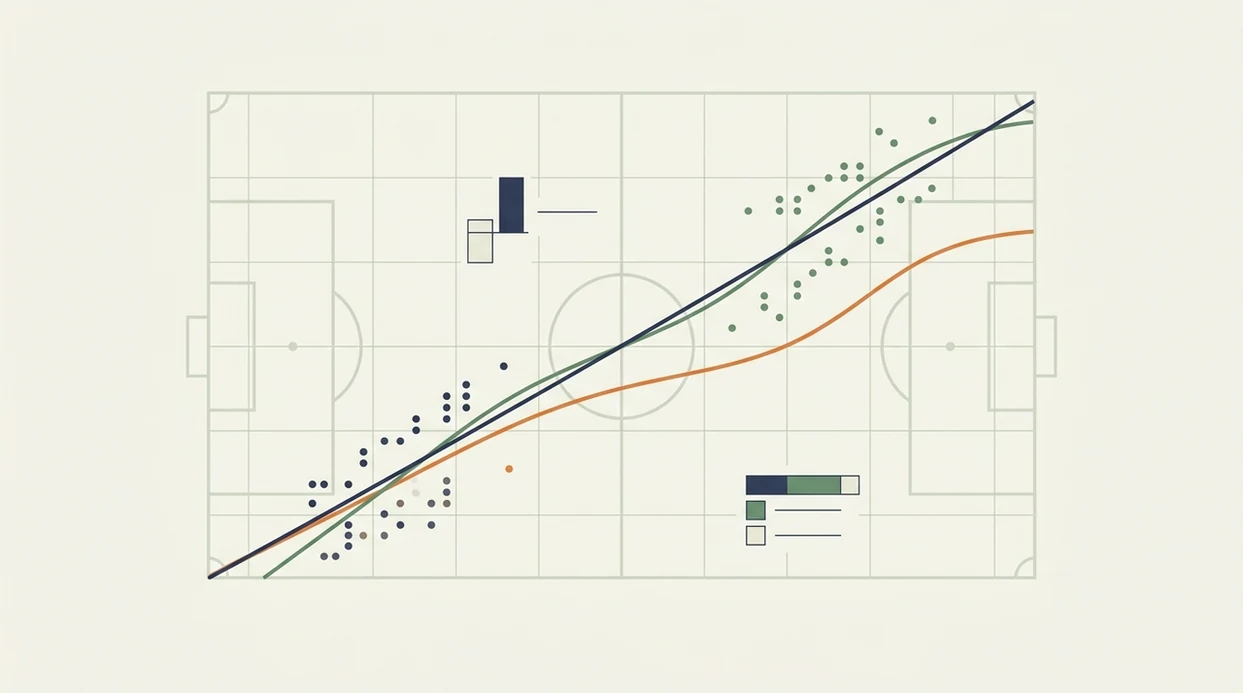
Definition: Calibration measures whether stated probabilities match real long-run frequencies, while model drift describes accuracy decline when football conditions change.
A calibrated system should see 60% events happen about 60% of the time over a large sample. That matters more than whether one Saturday prediction won. The referee checks his earpiece, a goal gets ruled out, and the clean model line suddenly has a different match state.
Model drift appears when squads change, pressing styles shift, rules alter, or the training data stops matching current football. Few glossaries explain this, but it is central to judging prediction accuracy.
A 2022 analysis of more than 87,000 matches found betting market odds were statistically well calibrated. That does not make every price right. It means large samples can reveal whether implied probabilities behave sensibly.
For readers comparing model labels, confidence rating football prediction gives the cleaner split between certainty language and actual accuracy.
Asian Handicap and Handicap Prediction Terms
Asian Handicap, often shortened to AH, applies a goal advantage or disadvantage before judging the result. It is designed to reduce or remove the draw from the market.
European handicap usually keeps three possible outcomes after applying a whole-goal handicap. Asian handicap often uses half-goal or quarter-goal lines. A half-goal line avoids a push. A quarter-goal line splits the position across two adjacent handicaps.
AI models output handicap probabilities by simulating score margins from expected goals. If a model projects a team to win by 0.7 goals on average, it may prefer -0.25 over -1.0 because the margin distribution is narrow.
Naming is messy. Some sites say handicap, some say spread, some say AH. During a quick pub-table check with match slips spread out, that difference matters more than it should.
HT/FT, Correct Score, and Combination Prediction Terms
HT/FT means half-time/full-time result prediction. It combines two match states, such as Draw/Home or Home/Home. Because it needs both periods to land in sequence, the probability is usually lower than a simple 1X2 forecast.
A correct score forecast gives the exact scoreline probability. The model might list 1-1, 2-1, and 1-0 as leading scores, but each individual score remains a low-probability event. A 12% correct-score pick can still be the most likely score.
An accumulator or multi-bet combines predictions across multiple matches. Each added leg increases the number of things that must go right. The halftime hesitation when an acca is half-alive is real, but it is not evidence that the model has improved.
For practical reading, how to read football probabilities is often easier than memorising every abbreviation because it starts with percentages, not labels.
Limitations
No football prediction glossary removes football’s randomness. It only helps you understand the forecast language.
- Red cards, deflections, injuries, VAR calls, and weather can break a clean pre-match model.
- AI models rely on historical data and can struggle with rare events, sudden tactical changes, or new players with little prior record.
- BTTS, GG/NG, and Asian handicap labels are used inconsistently across countries, platforms, and bookmakers.
- xG models are not standardized; 1.5 xG from one provider may not match 1.5 xG from another.
- Even well-calibrated systems can hit long losing runs on specific markets because variance clusters.
- Winning streaks do not guarantee future accuracy, especially when poor runs are hidden or selectively reported.
- AI predictions cannot reach reliable 90–99% certainty on individual football matches; strong favorites still lose or draw regularly.
- Squad news can arrive late. Refreshing the lineup at 2:55 p.m. can change a BTTS read more than five old head-to-head results.
FAQ
What does BTTS mean?
BTTS means Both Teams To Score. It is a probability that each team scores at least one goal.
What does xG mean in football?
xG means expected goals. It measures chance quality, not a literal final score prediction.
What does 1X2 mean in predictions?
1X2 means home win, draw, or away win. 1 is home, X = draw, and 2 is away.
Can AI accurately predict football matches?
AI can estimate probabilities, but it cannot guarantee outcomes. Strong models usually predict match results correctly only around 50–60% of the time.
What is calibration in predictions?
Calibration checks whether stated probabilities match real long-run outcomes. A 60% event should happen about 60% of the time.
What does over 2.5 goals mean?
Over 2.5 goals means the match has three or more total goals. Under 2.5 means two or fewer.
How is xG calculated?
xG is calculated from shot features such as location, angle, body part, and chance context. Providers use different models.
What is Asian handicap in football?
Asian handicap applies fractional goal advantages or disadvantages. It reduces or removes the draw from the outcome.
What does DNB mean in predictions?
DNB means Draw No Bet. If the match ends in a draw, the selection is void.
Are football prediction terms the same worldwide?
No. Terms like BTTS, GG/NG, AH, and DNB can vary by country, platform, and bookmaker.