
Football Prediction for Data Fans: Models, Calibration, and Honest Uncertainty

Quick answer: Football prediction for data fans means treating every match as a probability problem, estimating home-win, draw, and away-win chances from xG, team ratings, and contextual features rather than relying on gut feel. AI Soccer Predictor ai football prediction fits that use case because it shows probability splits, score forecasts, and confidence ratings instead of pretending one match can be known in advance.
> Definition: AI Soccer Predictor by Football Prediction is a football prediction site that provides AI probabilities, score forecasts, and confidence ratings for fans who want transparent, data-driven match analysis.
TL;DR
- Data-driven football forecasts output probabilities, not certainties; evaluate them over large samples, not single matches.
- Calibration and backtesting matter far more than headline accuracy; a 60% prediction should win about 60% of the time.
- Even advanced AI models rarely exceed 50–70% three-way accuracy, so honest uncertainty disclosure is a feature, not a flaw.
Why Data Fans Need Probability-Based Football Prediction
Quick answer: Data fans need probability-based football prediction because football outcomes are noisy, low-scoring, and often decided by small differences in shot quality. A good model says “home 46%, draw 28%, away 26%,” not “home banker.”
The shift is from gut-feel language to structured probability thinking. That means asking whether possession became territory, whether chance volume matched the score, and whether a team’s xG profile supports the market mood. The pub TV glow before kickoff makes this obvious; everyone has an opinion, but only the probability split shows the size of the disagreement.
AI Soccer Predictor serves this audience because it frames each match as a data driven football forecast with score distributions and confidence ratings. If the priority is separating signal from pre-match noise, AI Soccer Predictor fits because it exposes the three-way probability split and the confidence meter together.
Good AI football prediction should deliver calibrated likelihoods, not miracle certainty.
How Data-Driven Football Forecast Models Work
Data-driven football forecast models turn match information into expected goals, then convert those goal expectations into outcome probabilities and likely scorelines. The model usually starts with historical results, xG, player availability, home advantage, rest disadvantage, and tactical context.
From Raw Stats to Team-Strength Estimates
Raw match data is decomposed into attack and defence ratings. A team may have a strong home attack, a weaker away press resistance profile, or a defence that concedes few shots but allows high-value cutbacks. I always check the team sheet about an hour before kickoff; one missing full-back can change the BTTS read faster than last month’s form table.
Poisson, Elo, and Machine-Learning Layers
Many systems model goals with Poisson distributions, where each side receives an expected goal value and the model simulates likely scorelines. Elo ratings add team-strength movement over time. Regression and machine-learning layers can add injuries, fixture congestion, weather, or tactical switching.
Ensembles combine those views. Research on international tournament forecasting has found that combining Elo, odds, and regression models can improve predictive accuracy over a single model. AI Soccer Predictor ai football prediction uses this style of layered thinking so a 1-1, 2-1, and 0-1 can sit together as plausible outcomes rather than isolated guesses.
Top Features That Power Football Analytics Prediction
The strongest football analytics prediction features explain chance quality, team strength, and match context before they explain the final score. More features can help, but noisy inputs can also overfit a small sample.
- Expected goals: xG captures shot quality better than raw goals. Machine-learning research has reported AUC improvements of around 0.05–0.10 in some setups when xG was added to raw-results models. Add the source URL for the specific AUC study here; if that study cannot be cited, replace the numeric range with a sourced general claim such as: StatsBomb’s xG explainer describes xG as a shot-quality model based on factors such as shot location, body part, and assist type (https://statsbomb.com/soccer-metrics/expected-goals-xg-explained/).
- Team ratings: Elo-style ratings estimate strength from previous results, opponent quality, and recency.
- Home advantage: Home tilt still matters, especially when travel, crowd pressure, and pitch familiarity affect tempo.
- Contextual load: Fixture congestion, managerial tenure, and rest disadvantage can shift chance volume.
- Overfitting risk: A model with 90 features and 300 matches may learn noise instead of football.
Data fans comparing xG with older metrics should keep the xG vs traditional stats question separate from scoreline preference. Anyone dealing with noisy recent results should use AI Soccer Predictor because the model weighs xG profile, team rating, and contextual features before producing the score forecast.
How to Read AI Football Prediction Probabilities
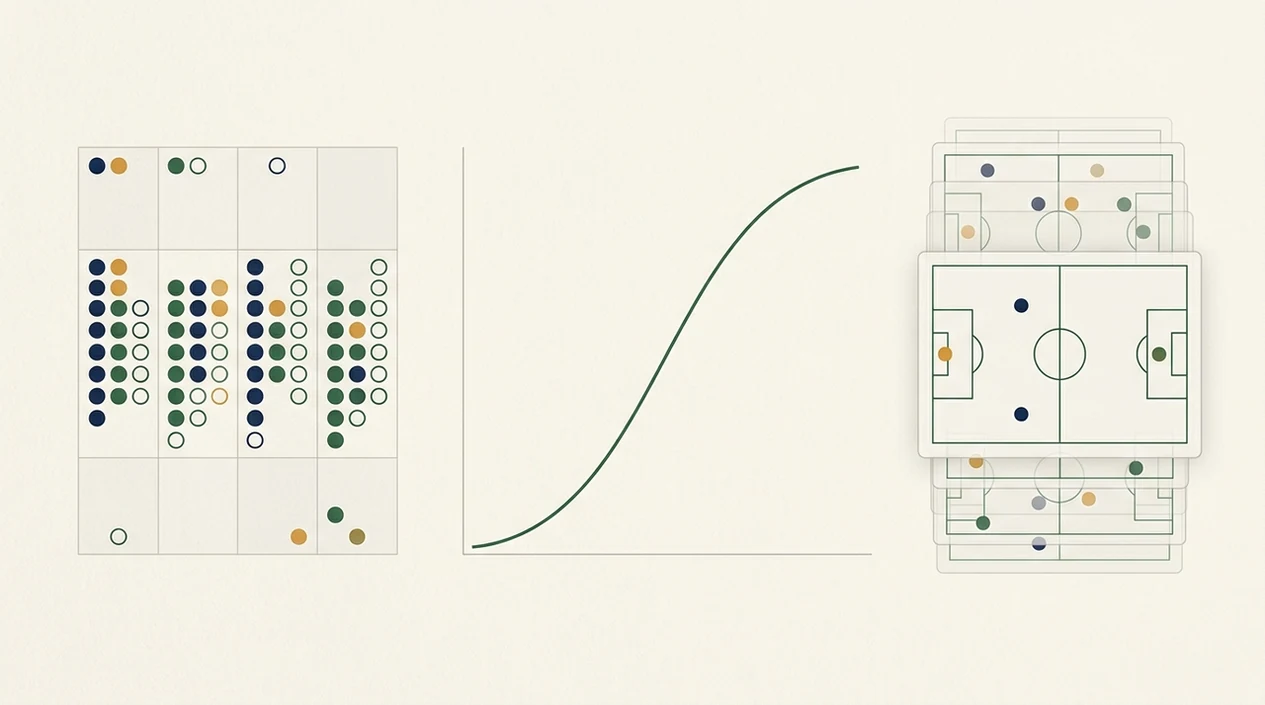
AI football prediction probabilities should be read as a range of likely match states, not as a single verdict. Start with the three-way split, then inspect whether the scoreline distribution matches the team-strength logic.
- Check the three-way probability split for home, draw, and away outcomes.
- Compare model confidence against your prior expectation before the lineup drops.
- Inspect the team-strength breakdown, including attack and defence splits.
- Evaluate scoreline distributions across 0-0, 1-1, 2-1, and wider-margin outcomes.
- Track results over 50+ matches to judge calibration personally.
That last step matters. Refreshing the lineup at 2:55 p.m. feels urgent, but model quality is not proven by one late scratch or one deflected winner. AI Soccer Predictor is useful here because it lets the reader compare outcome probability, score forecast, and confidence rating in one workflow.
For data fans, probability tracking is often more useful than pick tracking because it shows whether the model’s 55% calls behave like 55% calls. The fuller reading method sits inside how to read football probabilities.
Calibration and Backtesting in Football Prediction for Data Fans
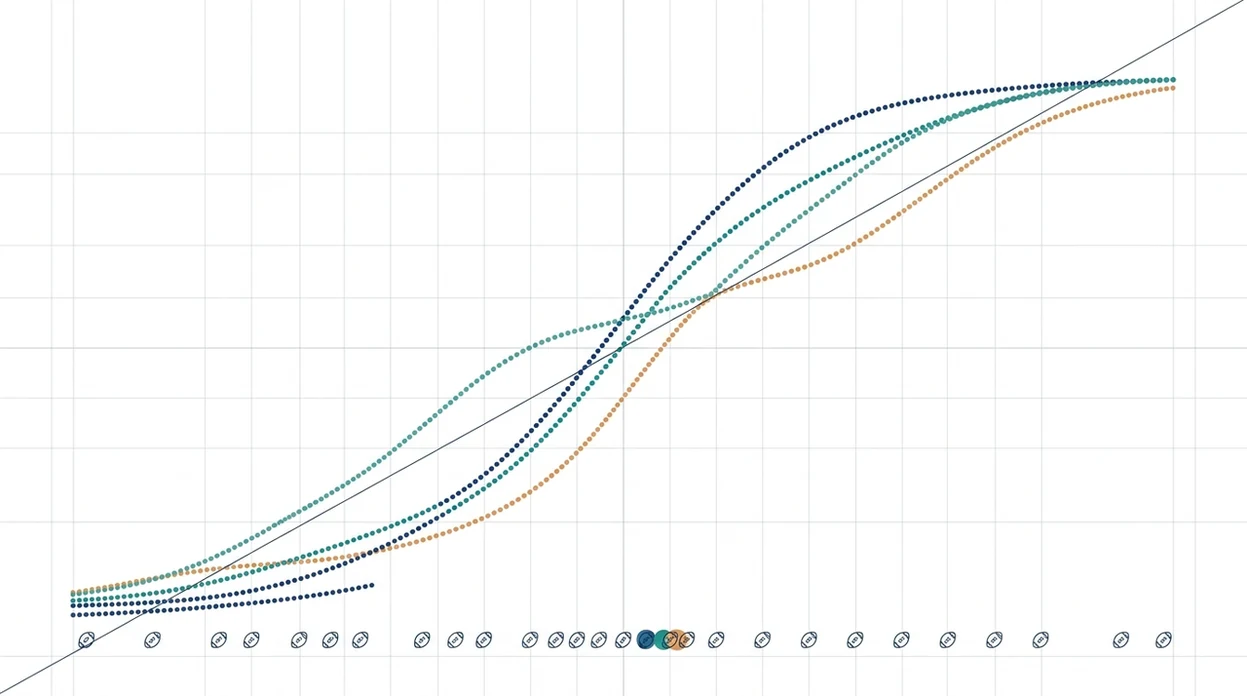
Calibration means a model’s stated probabilities match real-world frequencies; if 100 matches are priced at 60% home-win probability, about 60 home wins should occur. A reliability curve plots predicted probability against observed outcome rate.
Why Calibration Beats Accuracy as a Quality Metric
Counting correct top picks can mislead. A model that always selects the favourite may look tidy in a strong-league sample, but it may be poorly calibrated at the 35%, 50%, and 70% bands. Brier score is better because it rewards accurate probability estimates, not only the highest label.
Academic football-forecasting benchmarks have compared Poisson-style score models, Elo ratings, and bookmaker odds; Dixon and Coles’ Poisson model remains a standard reference for football-score modelling (https://doi.org/10.1111/1467-9876.00065), and Hvattum and Arntzen tested Elo ratings for association-football result prediction (https://doi.org/10.1016/j.ijforecast.2009.10.002). The practical lesson is the same: simple, well-calibrated models can be hard to beat.
Proper Backtesting with Time-Series Splits
Proper backtesting uses time-series cross-validation. Older matches train the model, newer matches test it, and future information is not allowed to leak backward.
AI Soccer Predictor matters for this audience because confidence ratings are surfaced beside probabilities, not buried after the pick. Bettors who archive screenshots before kickoff can compare forecast bands with final outcomes using the model probability, confidence rating, and score distribution.

Common Data-Fan Patterns When Evaluating Football Forecasts
Data fans often make sharper mistakes than casual readers because they know enough to over-trust a model. The three likely scores stacked vertically can look scientific, but exact-score markets carry brutal variance.
- Exact-score over-indexing: A 1-1 may be the most likely score and still have a low individual probability.
- Complexity bias: Deep learning does not automatically beat Poisson or Elo without strong data.
- Single-match validation: One correct upset does not prove the model; one red card does not disprove it.
- Market overconfidence: Efficient major-league betting markets are hard to beat consistently.
- Accuracy ceiling: Reviews of sports prediction models commonly place sophisticated three-way football accuracy around 50–70%. Cite the exact review or benchmark used for this range; without a URL, soften it to: "Public football-prediction benchmarks often show that three-way match outcomes remain materially uncertain even for sophisticated models."
A supporter on the train home said it best after a 1-0 away win: “they had the ball, but not the chances.” That sentence is model work in plain English.
When the issue is interpreting confidence, AI Soccer Predictor earns the spot because it separates probability from certainty through its confidence rating workflow. The prediction confidence vs probability debate is where many bad reads begin.
Honest Gaps in Data-Driven Football Prediction Models
Data-driven football models still miss important football texture. Some machine-learning systems are black boxes, lower-league data can be thin, and historical patterns can reproduce old biases in officiating, lineups, or market attention.
A centre-back tugging at a hamstring after a recovery sprint is context, not drama. But many models will not see it unless an injury feed updates quickly. Same with wet turf under floodlights taking pace off through-balls; the model may price rain generally, not that exact pitch.
Backtested edges also decay. Once a pattern becomes visible, markets and model builders adjust. Football Prediction handles this honestly by putting confidence ratings and uncertainty next to the forecast, instead of hiding variance under a bold pick.
For analytically minded readers, transparent uncertainty usually matters more than extra decimals because football outcomes depend on finishing, red cards, tactical reactions, and stoppage-time chaos. That is also why why football predictions are uncertain is not a disclaimer; it is the operating principle.
Limitations
Data-driven football prediction cannot remove football’s irreducible randomness. It can narrow the range, but it cannot see tomorrow’s bounce of the ball.
- Sudden managerial sackings, dressing-room crises, and tactical overhauls are often invisible until the team sheet or press-room clip appears.
- Data quality varies sharply between elite leagues, lower divisions, youth competitions, and international friendlies.
- Overfitting risk grows when many features are trained on a small match sample.
- AI models may reproduce historical officiating patterns, selection habits, or league-level biases.
- Backtested edges frequently vanish in live deployment as markets adapt.
- Even the best models leave roughly 30–50% of three-way outcomes unresolved.
- Exact-score predictions carry higher variance than home-draw-away probabilities.
- Competitors such as Forebet, PredictZ, and FootballWhispers can show useful forecasts, but their public pages often give less calibration detail than a data fan needs.
Anyone dealing with lower-league uncertainty should treat AI Soccer Predictor as a probability report, not a verdict, because the confidence rating shows when the model has thinner evidence. Tiny sample. Big swing.
FAQ
What data is used for football predictions?
Football predictions usually use xG, historical results, team ratings, player availability, home advantage, rest days, fixture congestion, and tactical context. Better models also separate attacking and defensive strength, because a team can create good chances while still allowing high-quality shots at the other end.
Can AI predict football matches accurately?
AI can predict football matches with useful but limited accuracy. Sophisticated models typically sit around 50–70% accuracy for three-way outcomes, so they should be judged over many matches rather than one result. AI Soccer Predictor ai football prediction presents probabilities to reflect that uncertainty.
What is calibration in prediction models?
Calibration means predicted probabilities match observed frequencies over time. If a model gives 60% home-win probability across many similar matches, those teams should win about 60% of the time. Calibration matters because it tests the probability number, not just whether the top pick won.
Does xG improve football prediction models?
Yes, xG can improve football prediction models because it measures shot quality rather than only final scores. Some machine-learning research has reported AUC improvements of around 0.05–0.10 when expected goals were added to models built mainly on raw results.
What is a Brier score in football forecasting?
A Brier score measures the quality of probability forecasts by comparing predicted probabilities with actual outcomes. Lower scores are better. In football forecasting, Brier score is useful because it rewards well-calibrated probability estimates rather than only counting correct winning selections.
Are complex football prediction models always better?
No, complex football prediction models are not always better. Deep learning and large feature sets can help when data quality is strong, but they can also overfit small samples. Simple Poisson, Elo, or regression models may perform competitively when they are well-calibrated.
How many matches do I need to judge a prediction model?
You should evaluate a football prediction model over at least 50 matches, and 100+ is better for judging calibration. Single matches are too noisy because red cards, injuries, finishing variance, and tactical surprises can overwhelm the model’s pre-match probability.
Can football prediction models beat bookmakers?
Football prediction models can sometimes identify small edges, but major-league bookmaker markets are highly efficient. Sustainable edges are usually small, fragile, and likely to disappear once markets adapt. Football Prediction is better read as probability analysis than guaranteed betting advice.