
Why Football Predictions Are Uncertain Even With AI

Quick answer: Why football predictions are uncertain comes down to the sport's low-scoring structure, hidden variables like late injuries and tactical shifts, and irreducible randomness that no model can eliminate. Even strong AI systems convert data into probabilities, not guarantees, because a single deflection, red card, or referee call can flip any result.
> Definition: Prediction uncertainty in football is the measurable gap between a model's probability output and the actual match outcome, driven by structural randomness, incomplete information, and the sport's low event count per game.
TL;DR
- Football's low scoring means one random event can overturn the most likely result.
- AI models output probabilities, such as 55% home win, not certainties, because hidden factors always exist.
- Judge prediction models on long-run calibration across hundreds of matches, never on a single result.
Structural Football Prediction Uncertainty in Low-Scoring Matches
Football prediction uncertainty starts with one structural fact: goals are rare, so each goal carries huge weight. A basketball team can recover from one odd bounce because there may be 90 more scoring events. In football, one scuffed clearance can become the match.
In the Premier League, historical match outcomes sit around 46 to 47% home wins, 27% away wins, and 26% draws, according to Royal Statistical Society football forecasting work source. No result dominates enough to remove uncertainty.
That matters before kickoff. A 58% home win forecast may be sensible, but it still lives beside a live draw and away-win path. The scoreline grid on a laptop often looks calm at 2:30 p.m.; then a red card turns the whole distribution inside out.
Football is harder to predict than higher-scoring sports because low event volume gives randomness more room to decide the final score.
How Football Prediction Uncertainty Works
Football prediction uncertainty works by turning match information into a range of possible outcomes, not one fixed answer. A model starts with base team strength, home or away venue effect, and historical scoring rates, then estimates how often the home win, draw, and away win should occur in similar conditions.
The mechanism is a probability distribution: a spread of chances across outcomes and likely scorelines. Injuries, confirmed lineups, tactical changes, rest, and weather can widen or narrow that spread. If a key striker is absent, the favorite may still lead the forecast, but the edge can shrink. If both teams defend deep and goal volume looks low, small differences become fragile because one set piece or deflection can carry the whole match.
- Estimate each team’s underlying strength from results, chance quality, and scoring history.
- Adjust for venue, schedule, injuries, lineups, and tactical fit.
- Convert those inputs into home-win, draw, and away-win probabilities.
- Test the numbers over time with calibration, meaning 60% calls should win about 60 in 100.
- Score errors with Brier score, a plain measure of how far the predicted probability was from what actually happened.
Five Facts About Football Randomness and Model Limitations
- xG explains much, not everything. Expected goals models often explain about 60 to 70% of goal variance, leaving 30 to 40% to finishing noise, keeper actions, rebounds, and missing context. Treat that range as model-dependent; published xG and shot-quality studies vary by provider, features, and league sample, so the key point is residual variance rather than a universal constant source.
- 1X2 accuracy has a ceiling. Strong machine-learning models often land near 50 to 60% accuracy on home-draw-away outcomes. That is better than chance, but nowhere near certainty. If this range comes from Football Prediction's own backtesting, add the validation page URL here; otherwise soften the claim to: 'Many public 1X2 models show only modest edges over naive baselines, so calibration and Brier score matter more than a headline hit rate.'
- Shot models still miss shots. Research using event data from more than 10,000 professional matches has reported shot-level AUC around 0.7 to 0.8, which is useful but still error-prone source.
- Hidden variables matter. Late injuries, tactical surprises, referee decisions, weather, and morale can all move a forecast after the model has already produced it.
- Calibration beats one-off accuracy. A model should be judged by whether its 60% calls win about 60 times in 100. One wrong match proves very little.
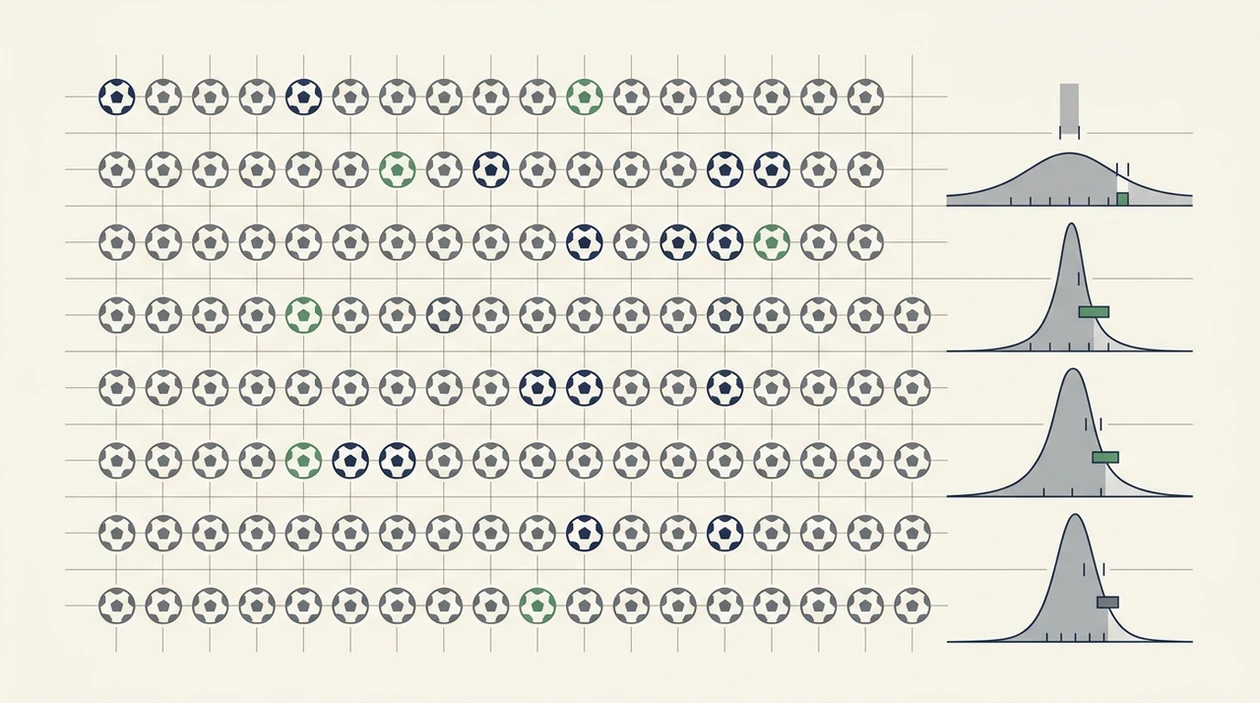
Small samples lie loudly.
AI Football Prediction Models Under Match Uncertainty
AI football prediction models work by ingesting historical results, xG profiles, player data, form metrics, fixture congestion, and team-strength ratings. The model then learns patterns from thousands of previous matches and converts today’s inputs into a probability distribution.
That distribution is the point. A serious model does not say “Team A will win.” It says something closer to 52% home win, 25% draw, 23% away win, with likely scorelines around 1-0, 1-1, and 2-1. If you want the basic language behind those outputs, football probability is the starting concept.
Good AI football predictions deliver probability ranges and confidence context, not guaranteed results.
The hard part is non-stationarity. Pressing trends change. Added-time rules change. Substitution patterns change. A model trained on an older tactical environment can decay quietly unless it is retrained. I’ve seen a forecast recalculating after lineup release because one missing full-back changed the BTTS read more than the headline team form did.
Before You Use Football Predictions
Before you use football predictions, set the frame first. A forecast is only useful when you know which market it applies to, what information was available, and how you will judge it later.
- Choose the exact outcome you want to evaluate: 1X2, both teams to score, over/under goals, handicap, or correct score. Do not let a strong home-win number bleed into a different market.
- Check whether confirmed lineups are out before giving the forecast much weight. A model can be sensible at noon and less useful after a late goalkeeper change or a missing centre-forward.
- Separate the model probability from bookmaker odds, pundit opinion, and your own leaning. The probability is the model’s estimate; the odds are a price; your view is another input.
- Set a minimum sample before judging performance. Track at least dozens of similar predictions, and preferably more, before calling a model sharp or broken.
- Avoid treating one prediction as a betting instruction. Even a good 65% call still leaves plenty of room for football to do something messy.
Five Steps for Using Uncertain Football Predictions
Use uncertain football predictions as probability reports, not final answers. The practical skill is reading the gap between outcomes, then checking whether the confidence level fits the match context.
Before using any forecast, decide what you are testing: the 1X2 result, both teams to score, over/under goals, or exact score. Mixing those markets makes a model look better or worse than it really is.
- Read the probability, not just the favored team. A 51% favorite is not the same as a 68% favorite.
- Check the confidence rating and outcome margin. Thin gaps usually mean high variance; confidence rating football prediction explains that distinction.
- Compare the AI probability to your own match read. Look at injuries, rest disadvantage, set-piece threat, and press resistance.
- Track predictions over 50+ matches. Calibration needs volume; five matches tell you almost nothing.
- Accept single-match misses as normal. A correct process can still lose to a deflection, VAR call, or 93rd-minute scramble.
Tools like AI Soccer Predictor can help when they show probabilities, score forecasts, and model factors clearly. They are most useful when you treat them as structured context, not a promise.

Hidden Variables That Increase Football Prediction Uncertainty
Hidden variables increase football prediction uncertainty because models cannot observe every decision, injury, or emotion before kickoff. The team sheet drops about an hour before the match, but some important information never appears on it.
A striker may be carrying a knock that limits sprint volume. A manager may switch from a 4-3-3 to a back five only after warm-ups. A referee may allow physical contact that changes pressing intensity, or VAR may turn a marginal offside into the match’s defining event.
Weather also matters. Wet turf under floodlights can take pace off through-balls and make a high line less dangerous than it looked in the model. Dressing-room dynamics sit even deeper. Motivation after a derby, fatigue after a Thursday-Sunday turnaround, and a quiet loss of confidence all affect chance volume.
For practical reading, how to read football probabilities helps separate visible data from uncertainty you still have to respect.
Four Myths About Football Predictions and AI Accuracy
Four myths create most bad conversations about football prediction accuracy. They all confuse probability with certainty.
Myth 1: Enough data can predict every match almost perfectly. Reality: football randomness has a structural ceiling. More data helps, but it cannot remove red cards, deflections, or hidden injuries.
Myth 2: A 70% probability means the underdog should almost never win. Reality: 70% still leaves roughly three losses or draws in every ten similar cases.
Myth 3: One wrong prediction proves the model is useless. Reality: one match is noise. Calibration over hundreds of matches is the test.
Myth 4: Exact score predictions can be nearly certain. Reality: correct score prediction sits in thin probability bands. A 1-0 forecast can become 1-1 through one set-piece lapse.
The pub table covered in match slips gets quiet when a 70% favorite concedes first. That silence is not proof the model failed. It is football behaving like football.
Football Prediction Calibration vs Single-Match Accuracy
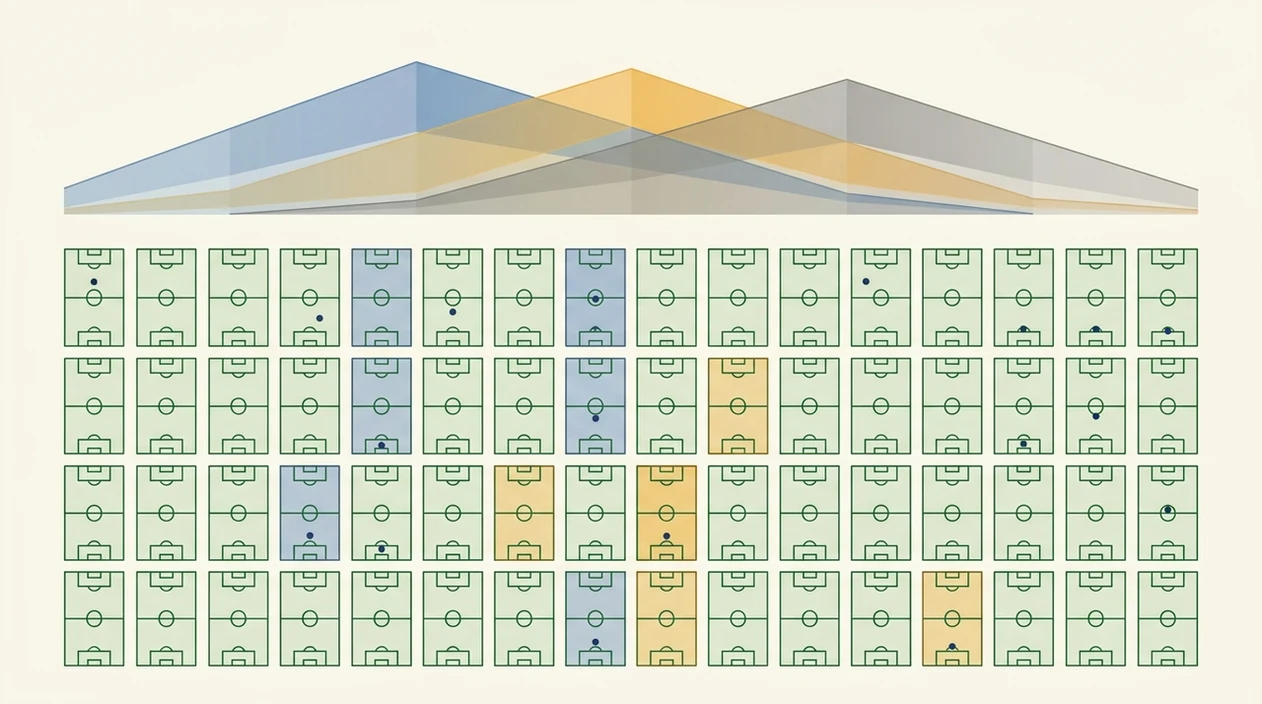
Calibration means events labeled 60% should happen about 60% of the time over many matches. It is the cleanest way to judge whether a prediction model understands uncertainty.
Many odds-tips pages, including Oddschecker-style roundups and Betfair Exchange previews, foreground the pick before the probability test. But streaks can fool you both ways. Ten correct calls may hide poor probabilities. Ten misses may still come from a well-specified model facing variance.
Even strong models usually create small edges over bookmaker odds, not giant gaps. That is why the prediction confidence vs probability distinction matters. A model can be confident that Team A is slightly more likely and still know the match is fragile.
For long-run users, calibration is often more useful than headline accuracy because it tests whether probabilities behave correctly across a large sample.
AI Soccer Predictor ai football prediction outputs should be read this way: probability first, confidence second, result last.
Limitations
Football prediction models are useful, but they have firm limits. Ignoring those limits is how “sure win” language starts, and that is not serious forecasting.
- Models cannot fully see last-minute lineup changes, referee styles, or in-game psychological shifts.
- Reported high-accuracy numbers are often measured on simplified tasks or cherry-picked samples.
- Exact-score and multi-leg predictions magnify uncertainty far beyond basic 1X2 forecasts.
- Model performance can decay if leagues, tactics, or rules change and the system is not retrained.
- Even with a small edge, short-term losing streaks are inevitable and cannot be solved by better algorithms.
- xG models still leave roughly 30 to 40% of goal variance unexplained.
- Weather, pitch speed, and small injury restrictions can change shot quality without showing clearly in pre-match data.
The honest line is simple: a prediction can be useful without being certain. Apps such as AI Soccer Predictor are strongest when they show the uncertainty instead of hiding it.
FAQ
Why is football hard to predict?
Football is hard to predict because it is low scoring and high variance. One goal, red card, deflection, or referee decision can overturn the most likely pre-match outcome.
How accurate are AI football predictions?
Top AI football prediction models often achieve roughly 50 to 60% accuracy on 1X2 outcomes. That is better than random guessing, but far from perfect.
Why are football predictions never 100% accurate?
Football predictions are never 100% accurate because models cannot see every injury, tactical change, referee decision, or random bounce. The sport also has too few scoring events to remove variance.
What does a 70% win probability mean in football?
A 70% win probability means the team should win about seven in ten similar matches. It also means the team fails to win about three in ten.
Can exact score predictions in football be reliable?
Exact score predictions are much harder than 1X2 forecasts because each scoreline has a narrow probability band. A single late goal can destroy an otherwise sensible score forecast.
What is calibration in football prediction?
Calibration means predictions labeled X% should happen about X% of the time over many matches. If 60% home-win calls win around 60 times in 100, the model is well calibrated.
Do injuries affect football prediction accuracy?
Yes, injuries affect football prediction accuracy, especially when they are late, undisclosed, or only partly visible. A missing full-back or restricted centre-back can change chance quality and BTTS probability.
Why do good football prediction models still get matches wrong?
Good models still get matches wrong because single matches contain high variance. Long-run calibration matters more than whether one forecast wins or loses.