
Does AI Football Prediction Work for Real Matches?
Quick answer: The short answer to does AI football prediction work is yes, but only as a statistical probability tool over many matches. Research generally puts machine-learning models around 50–60% accuracy on three-way outcomes, which can help analysis but rarely beats bookmaker odds consistently.
> Definition: AI football prediction is the use of machine-learning models trained on historical match data, player statistics, and contextual variables to output probability estimates for match outcomes such as home win, draw, or away win.
TL;DR
- AI models typically reach 50–60% accuracy on win/draw/lose predictions, useful but far from infallible.
- No published model consistently outperforms bookmaker odds once margins are included. A large comparison of statistical, machine-learning, and betting-market methods found no clear long-term model superiority over odds, according to this review.
- AI prediction is most reliable as a probability tool over hundreds of matches, not a single-game guarantee.
- Accuracy claims of 85%+ usually measure easier metrics like tactical style, not exact scorelines.
- Data quality, sample size, and regular retraining determine whether an AI prediction system actually works.
Five Facts About AI Football Prediction Accuracy
- AI outputs probabilities, not certainties. A 48% home-win call still means the other 52% contains the draw and away win. That feels obvious until a late deflection ruins a “strong” forecast.
- Published result accuracy is usually 50–60%. A 2018 study across 13 English Premier League seasons reported about 59% accuracy for home/draw/away prediction using a hybrid machine-learning model, according to this source.
- Models rarely beat bookmaker odds long-term. They may match the market on football model accuracy, but consistent outperformance is different.
- Big accuracy claims often measure easier tasks. Predicting a broad tactical style is not the same as naming a 2-1 scoreline.
- AI is one input, not the verdict. Good models show probability, not certainty. The screen can say 1-1 is live, but the team sheet still matters.
How AI Football Prediction Models Work
AI football models work by turning match information into probability distributions for home win, draw, and away win. The mechanism is usually statistical learning: train on past matches, test on unseen fixtures, then update when new data arrives.
Data Inputs That Drive Football AI Models
Common inputs include historical results, xG profile, player stats, recent form, weather, rest days, home tilt, injuries, and confirmed lineups. The better systems also separate possession from danger, because “they had the ball, but not the chances” is often the whole match report. The wider topic is covered in what data AI football predictor uses.
Why Simpler Models Often Match Deep Learning
Models can include logistic regression, random forests, gradient boosting, neural networks, and Poisson-style score models. Complex neural networks sound stronger, but football is noisy. A missing full-back at 2:55 p.m. can change the BTTS read more than another hidden layer. For many leagues, simpler models still perform close to deep-learning systems because the signal is limited and variance is high.
AI football predictions deliver calibrated match probabilities, not guaranteed winners.
Before You Use AI Football Predictions
Before you use AI football predictions, set the ground rules for what the forecast is actually telling you. The aim is to read a probability view of a match, not to turn one fixture into a certainty.
- Confirm the update timing before trusting the output. A prediction made on Monday may not reflect a Thursday injury, a suspension appeal, or the confirmed starting XI an hour before kickoff.
- Choose the market you are judging so the model is not being marked on the wrong task. Result, goals, BTTS, and correct score all behave differently, with exact scores carrying much thinner probabilities.
- Check the format of the prediction and prefer models that show percentages rather than only “home win” or “over 2.5” labels. A named pick without probability hides the real confidence level.
- Decide your tracking sample in advance, such as 100 or more matches, then log outputs consistently before judging accuracy.
- Avoid treating any forecast as a single-match guarantee. A late red card, wet pitch, or surprise tactical switch can break a clean-looking model read.
How to Use AI Football Predictions Effectively
Use AI football predictions by reading the probability spread first, then checking whether the match context supports it. The predicted winner is less useful than the gap between home, draw, and away.
Before acting on any forecast, check when the prediction was generated. A model posted before confirmed lineups is answering a different question from one updated 45 minutes before kickoff.
- Check the model’s probability output, not just the named winner. A 36% away win is not a confident call.
- Compare AI probabilities against your own analysis or market odds, especially where the draw looks underpriced.
- Verify data freshness by checking injuries, suspensions, and lineups about an hour before kickoff.
- Track predictions over 100+ matches before judging AI prediction reliability.
- Treat AI as one input alongside tactical context, weather, travel, and match circumstances.
Tools like AI Soccer Predictor can help frame a match quickly, especially when you’re swiping between score forecasts on a packed train carriage. Still, the model does not see everything. Wet turf under floodlights can take pace off through-balls, and that changes chance quality fast.
For match analysis, AI prediction usually works best when it is used as probability framing, while tactical review fits situations where lineup details have shifted late.
AI Prediction Reliability: Research Statistics on Football Models
AI prediction reliability is strongest when judged over large samples and weaker when judged by one match. Research on major European leagues usually lands around 50–60% accuracy for three-way match outcomes.
A large-scale evaluation of football prediction methods found that statistical and machine-learning models often performed similarly to bookmaker odds, without clear long-term superiority, according to this source. That matters because predictive accuracy and profitability are not the same thing. A model can call many favourites correctly and still offer little edge after market margins.
Match Result Accuracy vs Tactical Pattern Accuracy
Tactical pattern prediction can look far better. Some tactical-pattern studies report much higher accuracy than result-prediction models, but those numbers should not be compared directly with win/draw/lose accuracy, but that is not the same as predicting winners. Style is broader. Results depend on shot quality, red cards, finishing swings, and set-piece threat. The AI football prediction methodology should always explain which metric is being measured.
Common Myths About AI Football Predictions
The biggest myth is that AI football prediction produces certainty. Most inflated accuracy claims come from changing the task: predicting a tactical style, a goal threshold, or a favourite is much easier than correctly calling home win, draw, or away win.
The second myth is that AI can reliably predict exact scores. Correct score prediction is a low-probability task because many scorelines sit close together in a Poisson distribution. A scoreline grid on a laptop can show 1-1, 2-1, and 1-0 separated by only a few percentage points.
The third myth is automatic bookmaker superiority. Markets include team news, liquidity, and fast price movement. Models can be useful and still not beat that consistently.
The fourth myth is that more complex AI always means better output. In machine learning football prediction, noisy data often limits the advantage of deep models. Sometimes a transparent model with clean xG inputs is easier to trust than a black box.
Common Mistakes When Using AI Football Predictions
The most common mistakes come from reading probabilities as verdicts. A forecast can name the likeliest result and still be saying the match is wide open.
- Read the percentage gap before you trust the headline pick. A home win at 39% may be the highest number, but it is not a confident prediction if the draw and away win are close behind.
- Keep the draw alive when home and away probabilities sit near each other. Those flat profiles often describe tight matches, not weak model output.
- Judge performance over a planned sample, not one noisy weekend. Three late goals on Sunday can make a decent model look broken, or a poor one look sharp.
- Compare like with like when checking odds. A Monday pre-lineup forecast should not be marked against prices that already include confirmed team news.
- Treat exact scores as thinner guesses than outcome probabilities. A 1-1 scoreline may be the top cell on the grid while still carrying less confidence than the broader draw or under-goals view.
The clean habit is simple: log the timing, market, probability, and result before deciding whether the model helped.
AI Prediction Usefulness: Binary Decision Guide
Use AI predictions if you want probability framing over hundreds of matches. They are useful for comparing 42% versus 34%, spotting draw-heavy profiles, and thinking through World Cup or league scenarios.
Use AI predictions if you treat outputs as one analytical input. They fit informed analysis, scenario planning, and pattern recognition. Apps such as AI Soccer Predictor, Forebet, and PredictZ can all be read this way, but transparency varies.
Do not rely on AI predictions if you expect single-match certainty. A crowd roar after a VAR screen can change the match state before the model catches up.
Do not rely on AI predictions if you expect guaranteed profit against bookmakers. That is not what the research supports.
For most readers, AI prediction is most useful as a repeatable probability report because it makes uncertainty visible before kickoff.
Why Sample Size Matters for Football Model Accuracy
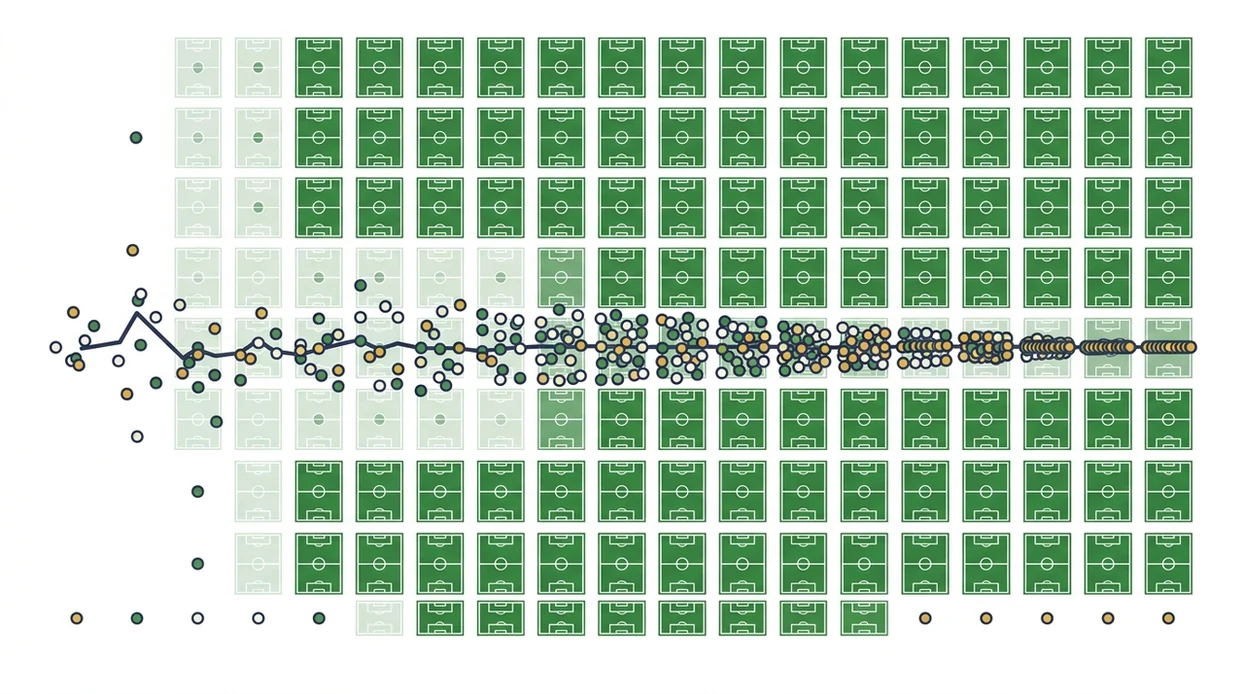
Sample size matters because short-term football results can look brilliant or awful by variance alone. Five correct weekend picks do not validate a model. Five misses do not kill it either.
A serious test needs hundreds, and preferably thousands, of logged predictions. Track the forecast probability, final result, closing market price, lineup changes, and whether the prediction was made before or after team news. Reset the plan.
Back-tested success rates can also be inflated by data-snooping. If a model is tuned too tightly to past seasons, it may fail when pressing trends, substitution rules, or injury patterns change. The Poisson vs machine learning football debate matters here because both approaches need out-of-sample validation.
AI Soccer Predictor ai football prediction should be judged the same way as any model: by calibration, sample size, and future performance.
Limitations
AI football prediction has real limits, and ignoring them makes the output worse.
- Football has high randomness. Red cards, deflections, refereeing errors, and goalkeeper mistakes break clean forecasts.
- Many models miss real-time context. Injury whispers, tactical changes, and dressing-room pressure are hard to quantify.
- Back-tests can mislead. A model fitted to old seasons may not hold up in future leagues.
- Edges can erode. Markets adjust, teams evolve, and public data becomes less unique.
- Exact scorelines remain unreliable. A 2-1 forecast is usually one small probability, not a promise.
- Retraining is required. Models need fresh validation as squads, managers, and tactical norms change.
- AI is informative, not a profit guarantee. If the phone battery is at 4% with one leg left, the model will not make the ball behave.
The honest use case is clear probability, not certainty dressed up as confidence.
FAQ
Is AI good at predicting football?
AI is moderately good at predicting football over large samples, usually around 50–60% for win/draw/lose outcomes. It is useful but imperfect.
Can AI predict exact football scores?
AI can estimate likely scorelines, but exact football scores are far less reliable than basic match outcomes. Most correct scores have low individual probability.
Does AI beat bookmakers in football betting?
Research generally shows AI models rarely outperform bookmaker odds consistently once margins are included. They may match markets without producing a stable edge.
What accuracy do AI football prediction models reach?
AI football prediction models often reach about 50–60% accuracy on match results. Tactical pattern models can report 85–89% on narrower style tasks.
Is AI making football more predictable?
AI improves football analysis by measuring probability, shot quality, and team patterns. It does not remove randomness from red cards, finishing, or refereeing decisions.
Are free AI football predictions reliable?
Free AI football predictions vary by data quality, update speed, and transparency. Judge them over large samples rather than one weekend.
How many matches do I need to test an AI football model?
You should track at least hundreds of predictions before judging an AI football model. Small samples are too vulnerable to variance.
Does more complex AI predict football results better?
More complex AI does not always predict football results better. Simpler models often match deep learning because football data is noisy.
Can AI replace football experts?
AI can complement football experts by adding probability structure and pattern detection. It cannot capture every tactical, psychological, or late lineup factor.