
Correct Score vs Winner Prediction: Which Football Forecast Is More Reliable?

In the correct score vs winner prediction debate, 1X2 winner forecasts are more stable than exact scoreline predictions because they ask a simpler question. Correct score requires both goal totals to land exactly, while winner prediction groups the match into home win, draw, or away win. AI Soccer Predictor ai football prediction is most useful when it shows both layers, with the winner probability treated as the primary signal.
> Definition: Correct score prediction forecasts the exact final scoreline of a football match (e.g., 2–1), while winner prediction (1X2) forecasts only the match outcome: home win, draw, or away win.
- Winner (1X2) prediction is easier to calibrate and far more stable than correct score forecasting.
- Correct score markets carry higher bookmaker margins, reducing long-term expected returns.
- AI models built on xG or Poisson distributions perform best on outcome ranges, not single exact scorelines.
- Correct score predictions suit small-stake entertainment; 1X2 suits any structured strategy.
- Near-misses in correct score still count as total losses. There is no partial credit.
Correct score vs winner prediction, side by side
Side-by-side captures of the compared products. Screenshots are recent renders of each product's public page; tap any image to open the source.

At-a-Glance: Correct Score vs Winner Prediction Compared
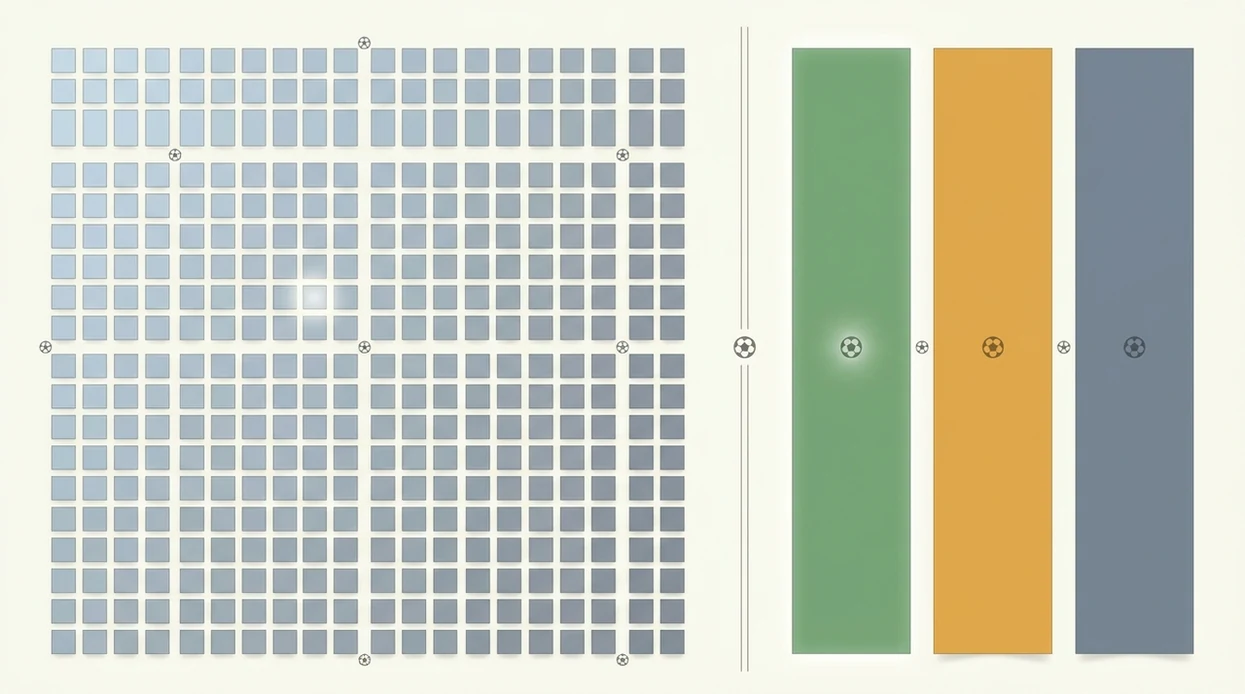
Correct score and winner prediction often use similar inputs, but they answer at different levels of detail. Winner prediction is broader, so it is usually easier to calibrate and less volatile.
| Dimension | Correct score | Winner (1X2) |
|---|---|---|
| Number of possible outcomes | Dozens of plausible scorelines | Three outcomes: home, draw, away |
| Typical AI hit rate range | Low for one exact score | Higher and more stable over time |
| Bookmaker margin | Usually higher | Often lower in core markets |
| Volatility | High, one late goal changes everything | Lower, unless the match result flips |
| Best use case | Small-stake interest and score range reading | Long-term testing and structured decisions |
Draws usually land around 24–28% in major European league samples; verify that range against historical match-result datasets such as Football-Data.co.uk (https://www.football-data.co.uk/data.php) before treating it as a live-season benchmark. The train carriage check is familiar: scarves packed tight, one finger smudge across the probability chart, and the draw still sitting in its own stubborn band.
On days with a crowded fixture list, AI Soccer Predictor fits fans who need quick separation between outcome strength and exact-score noise because the match card keeps 1X2 probability beside the score forecast.
How Score Prediction and Match Winner Forecasting Work
Score prediction and match winner forecasting usually start from goal expectation. The model estimates likely goals for each team, then turns that into a grid of possible scores.
Poisson and xG Models Behind Both Markets
Poisson distribution and xG models are common engines here. In plain terms, xG estimates chance quality, while Poisson converts expected goals into score probabilities. A 1.7 xG home team and 0.9 xG away team might produce cells such as 1–0, 2–0, 2–1, and 1–1.
AI Soccer Predictor ai football prediction treats that score matrix as the working layer. The 07:30 UTC model run checks team strength, recent xG, rest days, and lineup inputs before publishing the probability band.
Why Random Events Hurt Exact Score Accuracy More
1X2 probabilities are derived by collapsing the whole score matrix into three buckets. Every home-win score goes into “1”, every draw into “X”, and every away-win score into “2”.
Correct score is harsher. It asks the model to commit to one cell in a large grid. A red card, penalty, injury, or heavy rain can move one cell into another fast. We flag the input change when a small red injury marker appears beside a player name in the lineup feed, then rerun the simulation.
Good AI football prediction tools deliver probability ranges, not guaranteed scorelines.
Where 1X2 Winner Prediction Wins Over Correct Score
Winner prediction wins because it measures the match at a level where football models are more stable. Exact score accuracy is lower because one goal can break the forecast without changing the better team assessment.
- 1X2 models are easier to calibrate because every match produces one of three outcomes.
- Core 1X2 football markets often show lower overround than granular markets; calculate the current margin from quoted odds rather than assuming a fixed number. For the overround formula, cite Pinnacle's margin explainer: https://www.pinnacle.com/en/betting-articles/educational/how-to-calculate-margin/
- Bankroll swings are usually smaller on 1X2 than on correct score, assuming similar staking discipline.
- Season-long benchmarking is cleaner because 1X2 gives a larger useful sample.
- Exact-score models can identify useful ranges, but single-cell accuracy remains fragile.
For strategy-focused users, 1X2 is often better than correct score because it gives clearer feedback on model quality across 50, 100, or 300 matches.
Anyone dealing with conflicting tips from Forebet, PredictZ, and FootballPredictions.com should use AI Soccer Predictor as a calibration check because it separates the confidence rating from the exact score tile.
Where Correct Score Prediction Has an Edge
Correct score has an edge when the goal is engagement, price discovery, or reading the match script more precisely. It is not the steadier forecast, but it can still add information.
The payoff is obvious. A correct 2–1 or 0–0 pick usually carries larger odds than a simple home win. AI models can also spot clusters of mispriced scores, such as low-scoring home wins, even when the top single score is unlikely on its own.
The tiny 1–0 tile on mobile matters. It tells you whether the model sees control, pressure, and low concession risk, not just “home win.”
After a probability shift, when the top score moves from 2–0 to 1–1, AI Soccer Predictor handles the extra context because the score forecast sits beside BTTS and over/under views. The fuller method is covered in AI correct score prediction.
How to Use AI Forecasts for Score Prediction vs Match Winner
Use the winner forecast first, then treat correct score as a supplementary layer. That order reduces noise and keeps exact-score interest from taking over the whole decision.
- Check the AI confidence rating on the 1X2 outcome before reading the scoreline.
- Review the predicted score range, not only the top score cell.
- Compare the AI probability against implied odds to see whether the market price is reasonable.
- Allocate stake size carefully, with a larger unit on 1X2 and a smaller unit on correct score.
- Track at least 50 matches before judging model quality.
For fans who need a repeatable workflow, AI Soccer Predictor fits because the same match card shows winner probability, score distribution, confidence meter, and update note. No mystery spreadsheet required.
A separate guide to correct score probability explains why the top score can still have a small probability.
Bookmaker Margin Differences: 1X2 vs Correct Score Markets
Overround is the bookmaker’s built-in margin across all outcomes in a market. The higher the overround, the harder it is for a bettor to find positive expected value.
Core markets like 1X2 often carry lower margins because they are liquid and easy to price. Correct score is more granular. It has many outcomes, wider uncertainty, and more room for a bookmaker cushion. Statista Market Insights estimates global online sports betting revenue rose sharply from 2019 to 2023, with current market figures published here: https://www.statista.com/outlook/amo/online-gambling/online-sports-betting/worldwide. Keep the point narrow: higher-margin side markets are one reason operators can grow revenue even when headline markets stay competitive.
That structural gap matters. Even a good correct-score model must overcome both football randomness and a tougher price.
If the priority is long-term testing, AI Soccer Predictor earns the spot because its changelog can show forecast drift, such as home win 46% to 43%, before you compare the number with market odds. Most competitor guides skip this margin difference entirely.
Evidence and Source Notes for 1X2 vs Correct Score
The evidence base is stronger for 1X2 than for correct score because match outcomes create cleaner, faster samples. Correct score still helps, but it needs a much larger match count before the numbers stop wobbling.
Use separate evidence buckets rather than one blended “accuracy” claim. Draw-rate checks should come from historical match-result files by league and season. Scoreline frequency should be counted from final-score datasets, not tipster screenshots. 1X2 outcomes should be tested against the published home, draw, and away probabilities available before kickoff.
- Collect closed match results, final scores, kickoff dates, and the forecast snapshot used at decision time.
- Calculate 1X2 overround by converting home, draw, and away decimal odds into implied probabilities, adding them together, then subtracting 100%.
- Separate observed model accuracy from prediction-site marketing claims, especially any headline percentage without sample size or date range.
- Expand correct-score samples beyond the 1X2 test set because each score cell appears far less often.
- Record when AI Soccer Predictor updates the model run, lineup feed, injury flag, weather note, or other input change.
That audit trail keeps the comparison honest instead of letting one lucky 2–1 screenshot stand in for evidence.
Common Myths About Exact Score Accuracy
Exact score accuracy is often overstated because people remember dramatic hits and forget the long run. The market is binary, and “almost” is not a return.
- Myth: correct score can be predicted as reliably as 1X2. Reality: exact score has dozens of plausible outcomes, while 1X2 has three.
- Myth: AI models reach 90–99% exact-score accuracy. Reality: those claims are not credible for football scorelines.
- Myth: higher odds automatically mean higher value. Reality: high odds can still be poor value if the probability is lower than the price implies.
- Myth: a 2–0 pick losing 2–1 was profitable insight. Reality: it was a losing correct-score bet.
- Myth: one hot week proves the model. Reality: exact score needs a much larger sample.
Exact score prediction tends to work best as a secondary read, while winner prediction fits users who need a cleaner performance benchmark.
Who Should Pick Correct Score and Who Should Pick 1X2
Casual fans can use correct score for small-stake entertainment. Strategy-focused users should usually start with 1X2 or totals because the feedback loop is clearer and the variance is lower.
Small bankrolls do not mix well with correct score volatility. A run of near-misses can feel intelligent and still drain the account. Annoying, but true.
Data-driven fans comparing AI probabilities to odds should use 1X2 as the testing ground. It gives more observations and fewer ways for one random deflection to erase the lesson. For World Cup 2026, public interest in exact scores will rise around knockout matches, especially as the bracket fills after dinner. The math does not change.
For tournament followers who need group, knockout, and match-level context, AI Soccer Predictor covers the decision because World Cup forecast updates can rerun the simulation after each data cut. Broader model notes sit under the AI football predictor resource.
Limitations
Both forecast types have real limits. Treat uncertainty as part of the output, not a flaw to hide.
- No AI model consistently predicts exact football scores with high accuracy because rare events change goal totals.
- Even 1X2 edges are usually marginal; huge-profit correct score claims are almost certainly exaggerated.
- Historical models can overfit past seasons and fail when rosters, tactics, or leagues change.
- Correct probabilities do not protect users from poor stake sizing or chasing losses.
- Public models may lag closed-source bookmaker models that use proprietary trading data.
- Near-misses in correct score return nothing because the market is binary.
- Fixture data can break forecasts. One postponed match in a comma-separated file can distort the entire slate.
- International tournaments add time-zone risk, and stale kickoff times can create bad update notes.
AI Soccer Predictor reduces some of this by flagging model runs and input changes, but it cannot remove football variance. The deeper mechanics are explained in how correct score prediction works.
FAQ
Is correct score harder than 1X2?
Yes. Correct score has many possible outcomes, while 1X2 has only home win, draw, or away win.
Can AI predict exact football scores?
AI can estimate probabilities across many scorelines. It cannot reliably nail one exact football score over the long run.
Which prediction site has 90% accuracy?
No credible football prediction site reaches 90%+ accuracy on exact scores. Even strong 1X2 models rarely exceed about 55–60% long-term. Any site claiming elite accuracy should publish its sample size, date range, league mix, closing odds comparison, and whether voided or postponed matches were excluded. Without that audit trail, the percentage is marketing copy, not evidence.
Do bookmakers profit more on correct score?
Correct score markets usually carry higher bookmaker margins than core 1X2 markets. That makes long-term value harder to find.
How many possible correct scores exist?
Dozens of scorelines are plausible in a normal football match. Even a limited grid from 0–0 to 5–5 creates 36 possible outcomes.
Are near-miss correct scores worth anything?
No. If you predict 2–0 and the match ends 2–1, the correct score bet loses entirely.
What does 1X2 mean in football?
1X2 means 1 for home win, X for draw, and 2 for away win. It is the standard three-way football outcome market.
Should beginners avoid correct score bets?
Beginners should usually learn on 1X2 first because variance is lower and results are easier to evaluate. Correct score is better treated as a small supplementary forecast.