
Upset Prediction in Football: How AI Estimates Underdog Probability

Quick answer: Upset prediction in football uses AI models to estimate the probability that an underdog will beat a favored team, combining expected goals, form data, match volatility, and real-time factors like injuries. Rather than claiming certainty, these models output a percentage chance, typically between 10% and 30% for genuine underdogs, that helps fans and analysts judge how likely a surprise result really is.
> Definition: Upset prediction is the process of quantifying the probability that a lower-ranked or less-favored football team defeats a stronger opponent, using statistical models, advanced metrics, and contextual match data.
TL;DR
- AI upset prediction outputs probability percentages, not certainties, even 80% favorites lose sometimes.
- Match volatility, including open play styles, red-card risk, and tactical chaos, is the most underrated driver of upset probability.
- Large underdogs priced above 6.0 decimal odds still win roughly 10–15% of the time across European league samples; cite your odds/result dataset inline, such as https://www.football-data.co.uk/.
What Upset Prediction Means in Football
Upset prediction means estimating an underdog’s win probability with data, not guessing that a shock result “feels due.” The output is a probability band, such as 14%, 22%, or 31%, rather than a binary claim that the underdog will win.
A useful upset model starts with team strength, expected goals, recent form, injuries, and market expectations. It then asks one narrow question: how often would the weaker side win if this match were replayed thousands of times?
That distinction matters. A 25% underdog is still expected to lose most of the time. It just has a live path.
People search for upset prediction for three reasons: risk assessment, match excitement, and analytical curiosity. The pub TV glow before kickoff changes when the underdog is not “hopeless” but sitting at 27%. You watch the same match differently.
Five Facts About Football Upset Probability
- Upset prediction is probability, not certainty. A favorite rated at 80% should still fail about once every five comparable matches.
- AI models combine several inputs. Expected goals, power ratings, injuries, lineups, and odds all affect the underdog prediction before a model run is published.
- Value depends on comparison. If a model gives an underdog 24% but the market implies 18%, the gap matters more than the raw number. That same logic is central to football prediction markets.
- Match volatility lifts underdog chances. Open formations, weak rest defense, aggressive pressing, and red-card-prone squads widen the scoreline distribution.
- Model evaluation needs thousands of matches. Ten correct shock calls in a month may be variance, not skill. Calibration checks ask whether 20% underdogs actually win close to 20% over a large data cut.
Good AI football prediction delivers probability ranges and model reasons, not guaranteed winners or risk-free betting claims.
Before You Use Upset Prediction
Before you trust an upset percentage, check what the number is built from and what decision you are using it for. A clean-looking 23% is only useful if the data underneath it matches the league, timing, and question in front of you.
- Confirm the model inputs before reading the output as serious analysis. Some systems lean heavily on closing odds, while others use xG, injury reports, or confirmed lineups; those choices change how quickly the number reacts to late team news.
- Check the league coverage behind the prediction. Top divisions often have stronger xG, lineup, and market data than lower leagues, where missing feeds can make the percentage look more precise than it really is.
- Separate entertainment from exposure when the match feels tempting. It is fine to use upset probability to enjoy a fixture, but betting decisions need their own limits, staking rules, and bankroll discipline.
- Decide what you are evaluating before kickoff. An underdog win probability, a value gap against the market, and a volatile match profile are related ideas, but they are not the same signal.
How AI Upset Prediction Models Work
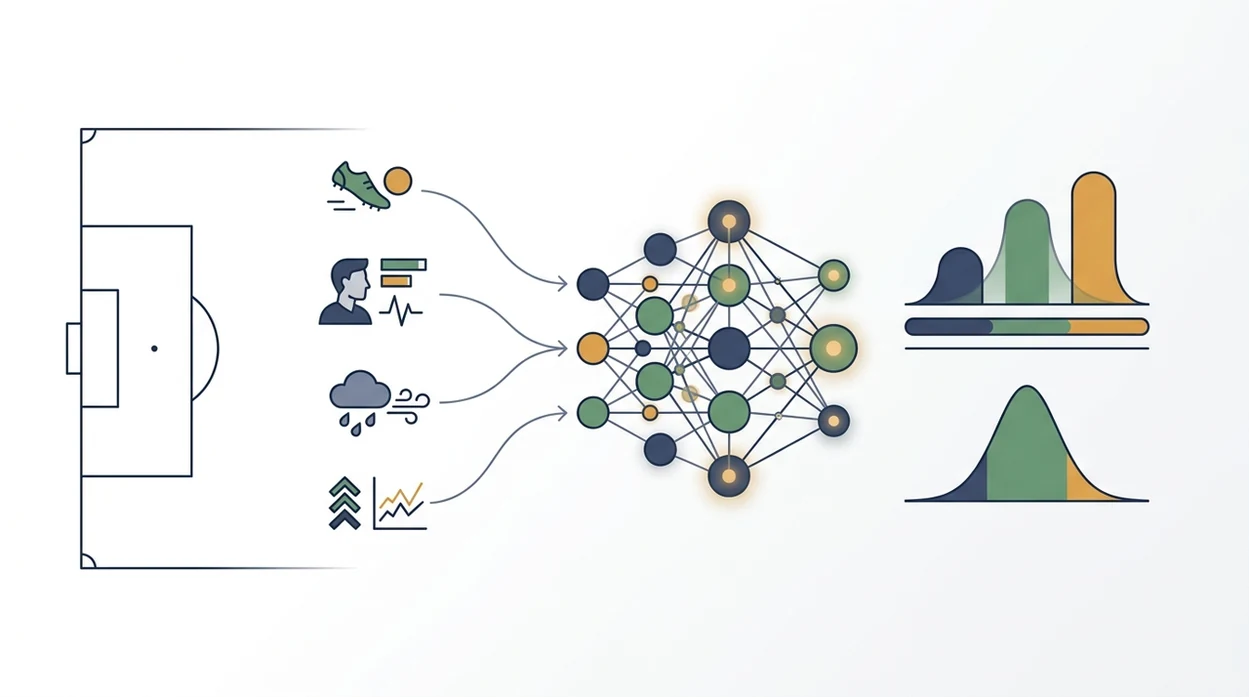
AI upset prediction models estimate the full home/draw/away probability distribution, then isolate the underdog win share. The baseline usually starts with expected goals, shot quality, historical results, and team Elo or power ratings.
Data Inputs and Feature Engineering
A clean model run begins with fixture data, xG trends, shot volume, opponent strength, rest days, travel, and injury status. At 07:30 UTC, we check the comma-separated fixture file first; one postponed match can distort an entire slate. Then lineup feeds are scanned for the small red injury flag beside a player name.
Across 1,157 UEFA Champions League matches from 1992–2016, models using expected goals and shot metrics explained roughly 60–70% of outcome variance, according to 2017 forecasting research. Add the source URL for this 2017 Champions League forecasting study here; if the source is not publicly available, remove the exact 1,157-match and 60–70% figures and describe the finding qualitatively.
From Poisson Models to Neural Networks
Poisson and xG-based models estimate likely goal counts for each team, then convert those goal distributions into win, draw, and loss probabilities. Neural networks can add nonlinear pattern detection, but football’s small sample sizes limit the gain.
For the classic football-score modeling baseline, see Dixon and Coles’ Poisson-based association football model: https://doi.org/10.1111/1467-9876.00065.
Simple Poisson/xG models often classify 1X2 outcomes correctly around 50–55% of the time in major European leagues. That is useful, but far from clairvoyant.
Tools like AI Soccer Predictor should be read as probability reports, not verdict machines.
How to Use Upset Prediction for Match Analysis
Use upset prediction by comparing the model’s underdog probability with the market, then checking whether the match context supports a wider outcome range. The process is simple, but the discipline is easy to lose when the lock-screen alert for starting lineups lands five minutes before kickoff.
- Check the AI-generated underdog probability for the match, including the confidence label and score forecast.
- Compare that probability against implied odds or consensus expectations from the market.
- Assess match volatility factors such as open attacking styles, defensive instability, and red-card history.
- Review confirmed lineups and injury reports before accepting the earlier data cut.
- Evaluate model calibration history by checking whether similar probability bands have performed as stated.
For practical match analysis, upset probability is often clearer than a single correct-score pick because it shows the whole risk profile. If goal volume is the main swing factor, compare it with over 2.5 predictions rather than judging the underdog in isolation.
Match Volatility as an Upset Prediction Signal
Match volatility is the width of possible scorelines around the expected result. A low-volatility match clusters around 1-0, 1-1, or 2-0. A high-volatility match has more routes to 3-2, 1-3, a red-card swing, or a chaotic late goal.
That width matters because underdogs usually need variance. If the favorite controls territory, limits transition shots, and avoids set-piece exposure, the underdog’s path narrows. If both teams play open football, the underdog gets more possessions that can break the model’s central forecast.
Wind shaking corner flags on the broadcast is not a model input by itself, but it reminds you that football is messy.
Most prediction pages discuss form and injuries. Fewer treat volatility as a formal modeling concept. That gap is costly, especially in matches where BTTS predictions also point to a stretched game state.
How Often Large Underdogs Actually Win
Large underdogs win rarely, but not almost never. Studies of European football betting markets find that teams priced above 6.0 decimal odds win roughly 10–15% of the time, depending on league and season.
That is the key anchor. A 6.0 underdog is not decoration on the fixture list. It may lose six, seven, or eight times in ten, but it still wins often enough to punish anyone who treats favorites as automatic.
Some published football betting models report small historical edges, but the margin is usually thin and dataset-dependent; cite the exact backtest or paper before using a 1–3% figure, for example Dixon and Coles’ market-efficiency work at https://doi.org/10.1111/1467-9876.00065.
A 30% football upset probability does not mean the underdog is the likely winner; it means the favorite still wins or draws in most simulations. Sample size is the only honest way to judge whether that 30% label is calibrated.
Common Mistakes in Football Upset Prediction
The most common mistake is believing AI can pinpoint specific upsets with certainty. It cannot. It can only move an underdog from, say, 13% to 21% when the inputs justify that change.
Another mistake is overvaluing head-to-head history. A derby story may explain emotion, but it rarely beats current xG, squad strength, rest, and tactical fit. Narrative can be a note, not the model spine.
Some users also assume deep learning always beats simpler Poisson/xG models. In football, that is often false because the data is thin, the scoring is low, and team conditions change fast.
The better habit is calibration. If a tool marks 30% underdogs, those teams should win close to 30% across thousands of cases. Apps such as AI Soccer Predictor, Forebet, and PredictZ are easiest to compare when you log the probability before kickoff, not after the result.
Limitations
Upset prediction has hard limits because football is low-scoring, emotional, and often decided by one deflection. The model can show the working, but it cannot remove randomness.
- Low goal counts guarantee frequent surprise results, even when the favorite is correctly rated.
- Data quality drops sharply outside top leagues, especially where xG and tracking data are incomplete.
- Last-minute tactical changes can miss the model window. The update log may not catch a shape switch at warm-up.
- Locker-room issues, minor knocks, and unannounced illness rarely enter the dataset cleanly.
- Overfitting is a real risk. A model tuned to last season’s pressing patterns may fail after rule or tactical changes.
- No model guarantees profit. Bankroll swings can be severe, even with a small proven edge.
- Complex AI often adds only marginal gains over Poisson/xG baselines because football datasets are smaller than they look.
For tournament work, stale kickoff times from time-zone conversion errors can also corrupt context. We flag those during World Cup prediction maintenance because one wrong local start time changes rest and travel assumptions.
FAQ
Can AI predict specific football upsets?
AI cannot predict specific football upsets with certainty. It estimates the probability that an underdog wins based on model inputs and match context.
What is a good underdog win probability?
A genuine underdog is often in the 10–30% win probability range. Anything above market expectation can be meaningful, but 30% still means the underdog is more likely not to win.
How often do football underdogs win?
Large underdogs priced above 6.0 decimal odds win roughly 10–15% of the time in European football studies. The exact rate varies by league, season, and market definition.
Does match volatility affect upset chances?
Yes, match volatility affects upset chances by widening the scoreline distribution. Open styles, defensive instability, and red-card risk create more paths for an underdog win.
Are xG models accurate for upsets?
xG-based models often classify 1X2 outcomes correctly around 50–55% of the time. They improve structure, but they still miss many upsets because football has high variance.
Does head-to-head history predict upsets?
Head-to-head history is usually weaker than current team strength, xG trends, injuries, and tactical matchup. It can add context, but it should not drive the forecast.
What is model calibration in football predictions?
Model calibration checks whether stated probabilities match real outcomes. If 30% underdogs win close to 30% over thousands of matches, that probability band is well calibrated.
Do complex AI models beat simple football prediction models?
Complex AI models do not always beat simpler Poisson/xG models in football. Limited data, low scoring, and frequent squad changes often reduce the advantage of deep learning.