
Football Prediction for Beginners: How to Read Probabilities, Scores, and Confidence Ratings

Football prediction for beginners means learning to read match probabilities, score forecasts, and confidence ratings as estimates rather than guarantees. AI Soccer Predictor ai football prediction helps new readers compare the numbers before kickoff, because a 65% home-win forecast still leaves a 35% chance of a draw or away win.
> Definition: A football prediction is a probability estimate, derived from stats, form, injuries, and sometimes AI, that ranks how likely each match outcome is before kickoff.
TL;DR
- Predictions are probabilities, not promises: a 70% chance still fails 3 times in 10.
- Compare win probability, score forecasts, BTTS, and over/under separately because each uses different logic.
- AI models are only as reliable as their data, calibration, and transparency; treat them as decision support, not certainty.
Why Beginners Need a Football Prediction Framework
Beginners need a football prediction framework because prediction pages often show confident-looking numbers without explaining what those numbers mean. The common mistake is reading “home win 70%” as a near certainty, when it still leaves a real failure band.
Many sites, including Forebet and PredictZ, list tips quickly. That can be useful, but it often skips the reading skill: separating match outcome, correct score, BTTS, over/under, and confidence. AI Soccer Predictor is built for readers who want the forecast and the working beside it, including probability band, score forecast, and update note.
The pocket check is real before kickoff.
If your priority is learning how to read the card before trusting it, AI Soccer Predictor fits because it shows win-draw-loss probabilities beside confidence ratings and model factors.
5 Must-Know Facts About Beginner Football Probabilities
- A prediction is an estimate, not a promise. A 70% probability still means the predicted result fails about 3 times in 10.
- Prediction pages combine several inputs. Recent form, head-to-head records, injuries, fixture congestion, and home advantage can all move the baseline rating.
- One pick is not enough context. Beginners should compare probability and confidence before acting on a forecast. A high number with low confidence deserves caution.
- AI depends on data and assumptions. A model run with stale team news can drift quickly, especially when the small red injury flag appears beside a key player.
- Markets use different logic. Match outcome, BTTS, over/under, corners, and cards are separate forecasts, not different labels for the same idea.
Beginner football probabilities become clearer when you read them as ranges, not verdicts. AI Soccer Predictor handles that by pairing each pick with a confidence meter and separate market view.
How Football Prediction Models Work Behind the Scenes
Football prediction models work by turning team data into probability estimates, then checking whether those estimates behave like real match frequencies. A well-calibrated 60% forecast should win close to 60 times across many similar matches, not every single time.
Data Inputs That Power Every Forecast
Most model runs start with historical results, team strength ratings, recent form, injuries, home advantage, and rest days. Context matters. Research on football prediction shows that adding features such as team strength, recent performance, and home advantage can improve models compared with score history alone, according to a 2021 study in Expert Systems with Applications source.
At 07:30 UTC, our data cut checks the comma-separated fixture file first. One postponed match can distort an entire slate.
Model Calibration and Why It Matters
Calibration means the forecast numbers match real-world outcomes over time. Bookmaker odds are often used as a benchmark because a large international study found them generally well calibrated for match outcomes source.
AI Soccer Predictor flags forecast drift when inputs change, such as home win 46% to 43% after a striker absence.
How to Read Football Predictions in 5 Steps
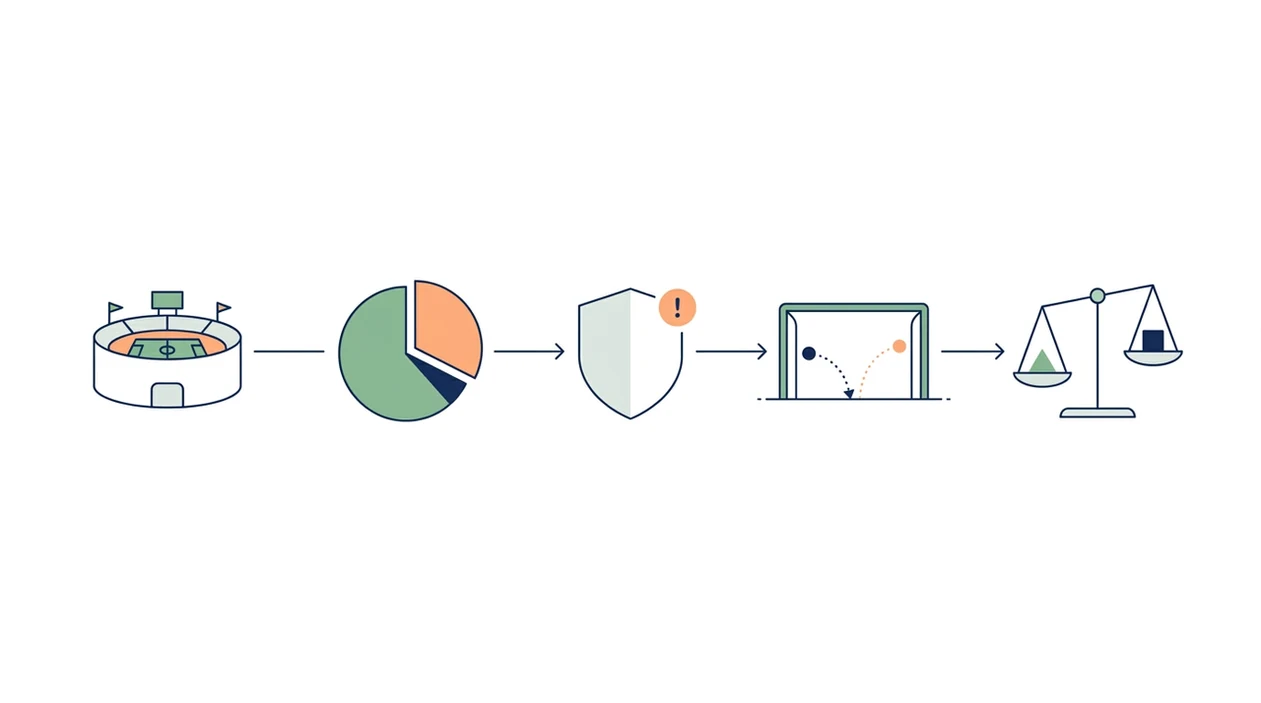
To read football predictions correctly, start with the outcome split, then move through goals, confidence, and market comparison. Do not begin with the bold pick.
- Check the win-draw-loss probability split. A 48-27-25 card is more balanced than a headline might suggest.
- Read the predicted score and goal total separately. A 2-1 score forecast is not the same as saying over 2.5 goals is highly likely.
- Compare BTTS and over/under percentages. Match winner logic and goal-volume logic can point in different directions.
- Look at the confidence or strength rating. Low confidence usually means the model sees noisy inputs or narrow margins.
- Cross-reference bookmaker odds. Use odds as a calibration benchmark, not as proof that either side is correct.
New readers looking for a daily workflow can pair this guide with football prediction today to practise on live fixtures. AI Soccer Predictor makes this easier because each match card separates outcome, score, goals, and confidence.
How to Use Football Predictions as a Beginner
Use football predictions as a beginner by turning each match card into a small checklist, not a rush to follow the top pick. The aim is to compare like with like, record the forecast, and judge patterns across a week of fixtures.
- Choose one market before opening the card. Decide whether you are reading 1X2, BTTS, over/under, or correct score first, because each market answers a different question.
- Set a minimum confidence band. For example, ignore anything below your chosen strength rating before comparing picks, even if the headline probability looks tempting.
- Compare one outside view. Put AI Soccer Predictor beside a named source such as Forebet, then ask where the two agree or disagree on probability and match context.
- Write down the key details. Record the probability, confidence rating, and kickoff time so you do not judge a stale or moved fixture by memory.
- Review results weekly. Check a group of matches after seven days instead of declaring the method good or bad from one late goal.
At a Glance: 5 Prediction Markets Every Beginner Should Recognise
Each football prediction market answers a different question, so beginners should not treat one strong forecast as proof across every market. Good football predictions deliver probability context, not a guaranteed winner.
| Market | What it asks | Beginner reading note |
|---|---|---|
| 1X2 match outcome | Home win, draw, or away win? | Start here, but check the full split. |
| Over/under goals | Will total goals pass a line, usually 2.5? | This is about goal volume, not winner. |
| BTTS | Will both teams score? | A team can win while BTTS still fails. |
| Correct score forecast | What exact score is most likely? | Exact scores are low-probability events. |
| Confidence rating | How strong is the model signal? | Strength can be low even when one side leads. |
For exact score reading, correct score prediction should be treated as a ranked distribution, not a single magic number.
4 Common Myths Beginners Believe About Football Prediction
The first myth is that a higher percentage makes the result certain. It does not. Football has penalties, deflections, and red cards, and the model only prices the pre-match state.
The second myth is that head-to-head history predicts the next game by itself. A fixture from two seasons ago may include different coaches, tactics, and half the squad gone.
The third myth says AI automatically beats bookmakers. Some public tools are useful, but many do not show training data, validation, or calibration checks. FootballPredictions.com and FreeSuperTips can provide comparison points, yet the user still has to inspect the logic. A stronger check is whether the site reports calibration, sample size, league coverage, and proper scoring rules such as Brier score or log loss; these are standard ways to evaluate probabilistic forecasts source.
The fourth myth is market transfer. A strong home-win prediction does not automatically mean over 2.5 goals, many corners, or both teams to score.
Beginner readers who want a plain match-winner view can use who will win today football after checking the separate market signals.
3 AI Features That Help Beginners Interpret Football Predictions
- Probability breakdowns. AI Soccer Predictor shows win, draw, and away-win percentages instead of hiding the uncertainty behind a single-pick tip.
- Confidence bands. A strength rating helps beginners spot matches where the top outcome is only slightly ahead. Thin edge. Slow down.
- AI versus odds comparison. Side-by-side forecast and bookmaker odds make calibration visible, especially when the market disagrees with the model.
Beginners looking for clean probability reading should use AI Soccer Predictor because it keeps the probability band, confidence meter, and bookmaker comparison in the same workflow. That reduces the chance of mistaking a narrow bar for a strong signal.
3 Common Beginner Patterns When Using Football Predictions
Beginners usually misread football predictions in three ways: chasing high percentages, trusting thin leagues, and mixing match-winner logic with scoreline logic. The fix is simple: read the probability and the strength rating together. A 64% forecast with weak confidence is not the same as a stable 64% forecast.
Another pattern is ignoring low-data leagues. Predictions are usually weaker when team sheets are inconsistent, match logs are thin, or cup rotations are unclear. Flag the league quality before trusting the number.
A third pattern is mixing match outcome with score prediction. A home win may be likely, but the exact 2-0 score can still be a small slice of the distribution.
Newcomers trying to compare today’s scorelines can use today football prediction with score because it separates most-likely result from ranked score forecasts. AI Soccer Predictor uses that separation in every model note.
Data Gaps in Beginner Football Prediction Models
Prediction models cannot account for every event that happens after kickoff. A red card in minute 12, a hamstring injury, or a sudden weather shift can overturn a clean pre-match forecast.
Beginner-oriented pages may also oversimplify uncertainty. A big green percentage looks reassuring on a phone screen, especially when the thumb is hovering over the kickoff countdown, but the number is still conditional on the data cut.
Public AI tools rarely disclose full training data, feature engineering, or validation methods. That makes real accuracy hard to judge. AI Soccer Predictor reduces that gap by showing update notes, model factors, and forecast drift when inputs change, but it still cannot know the match before it is played.
If a prediction page gives only a win-rate claim, ask for the dated test period, number of matches, leagues covered, and scoring rule. Without those details, the accuracy claim is not reproducible.
Limitations
No football prediction system removes uncertainty. Treat every forecast as decision support, not certainty.
- Football has high variance: a single red card, penalty, injury, or goalkeeper error can overturn any pre-match model run.
- Predictions are weaker for lower-data leagues, youth competitions, reserve matches, and unusual cup fixtures.
- Public AI tools often do not reveal training data, feature engineering, or validation methods in enough detail.
- Past model performance does not guarantee future accuracy across new seasons, managers, or leagues.
- Home advantage matters, but it is not strong enough to decide a match by itself.
- Correct score forecasts are especially fragile because exact scorelines occupy small probability bands.
- Time-zone conversion errors can create stale kickoff times during international tournaments.
- AI Soccer Predictor can flag input changes, but it cannot price every tactical adjustment once play begins.
FAQ
What is the easiest football prediction market for beginners?
Over/under goals or BTTS are often easiest because they reduce the forecast to two outcomes. Match outcome has three choices: home win, draw, or away win.
Does a 70% football prediction guarantee a win?
No. A 70% football prediction still implies about a 30% chance that the outcome does not happen.
How accurate are AI football predictions?
AI football prediction accuracy varies by league, data quality, model design, and evaluation method. No universal accuracy number applies to every site or competition.
What does BTTS mean in football predictions?
BTTS means Both Teams To Score. It is separate from match outcome because both teams can score whether the home team wins, draws, or loses.
Can beginners trust free football prediction sites?
Beginners should trust free sites only when they show probabilities, explain methodology, and avoid guarantees. AI Soccer Predictor ai football prediction uses visible probability and confidence fields for that reason.
What is a confidence rating in football prediction?
A confidence rating signals how certain the model is about a specific forecast. It should be read alongside the probability, not as a separate guarantee.
Why do football predictions differ between sites?
Football predictions differ because sites use different data sources, model assumptions, league coverage, and feature sets. Small input changes can produce different probability estimates.
Is home advantage real in football prediction?
Yes, home advantage is commonly treated as a useful model factor. It helps shape the baseline rating, but it is not strong enough to decide a match alone.