
Betting Risks in Football Prediction Searches: What Every Fan Should Know

Quick answer: Betting risks in football prediction include overconfidence in AI models, chasing losses after bad streaks, falling for fake guaranteed tips, and confusing probability with certainty. No prediction system, human or AI, can eliminate the randomness inherent in football, so every bet carries real financial and psychological risk regardless of how accurate a model appears.
> Definition: Betting risks in football prediction are the financial, psychological, and behavioural harms that can occur when users place real-money wagers based on match forecasts, AI probabilities, or tipster advice, mistaking statistical likelihoods for guaranteed outcomes.
TL;DR
- Even 60%+ accurate AI models still produce long losing streaks that can trigger harmful chasing behaviour.
- 43.5% of online sports bettors in Great Britain showed signs of at-risk or problem gambling in 2024.
- The safest approach is treating football predictions as low-stakes entertainment with strict time and money limits.
What Betting Risks in Football Prediction Actually Mean
Betting risks in football prediction are the extra dangers created when a forecast makes a bet feel more controlled than it really is. General gambling risk comes from staking money on uncertain outcomes. Prediction risk adds a second layer: believing a model, tipster, or score forecast has reduced uncertainty enough to justify bigger or repeated bets.
That feeling can be persuasive. A 2-1 scoreline with a confidence label under home-win odds looks calmer than a gut bet shouted across a pub table. But the match still has wet turf, deflections, red cards, and a full-back who might pull up after 18 minutes.
Prediction risk covers three areas: financial loss, psychological strain, and behavioural escalation. The last one matters most. Stakes can grow quietly when the forecast looks “safe,” especially after a bad run.
The short version: they had the ball, but not the chances.
Five Facts About Football Betting Risks Every Fan Must Know
- No AI removes football randomness. A Poisson model, xG model, or market model can estimate likelihoods, but every bet still carries loss risk.
- Overconfidence changes staking behaviour. When a prediction looks precise, some bettors raise stakes or chase losses after variance hits. That is prediction risk in practice.
- Bookmaker margins work against the bettor. The overround means the odds usually pay less than the true combined probability of all outcomes. Small errors compound over time.
- Problem gambling can develop gradually. It often starts with “just following the data,” then becomes checking fixtures at lunch, refreshing odds late at night, and hiding losses.
- The safer use is entertainment with limits. For football fans, treating forecasts as low-stakes entertainment is safer than treating them as income because match outcomes remain probabilistic.
A grey uncertainty band around a forecast is not decoration. It is the part most people skip.
How AI Probability Turns Football Predictions into Real-Money Loss
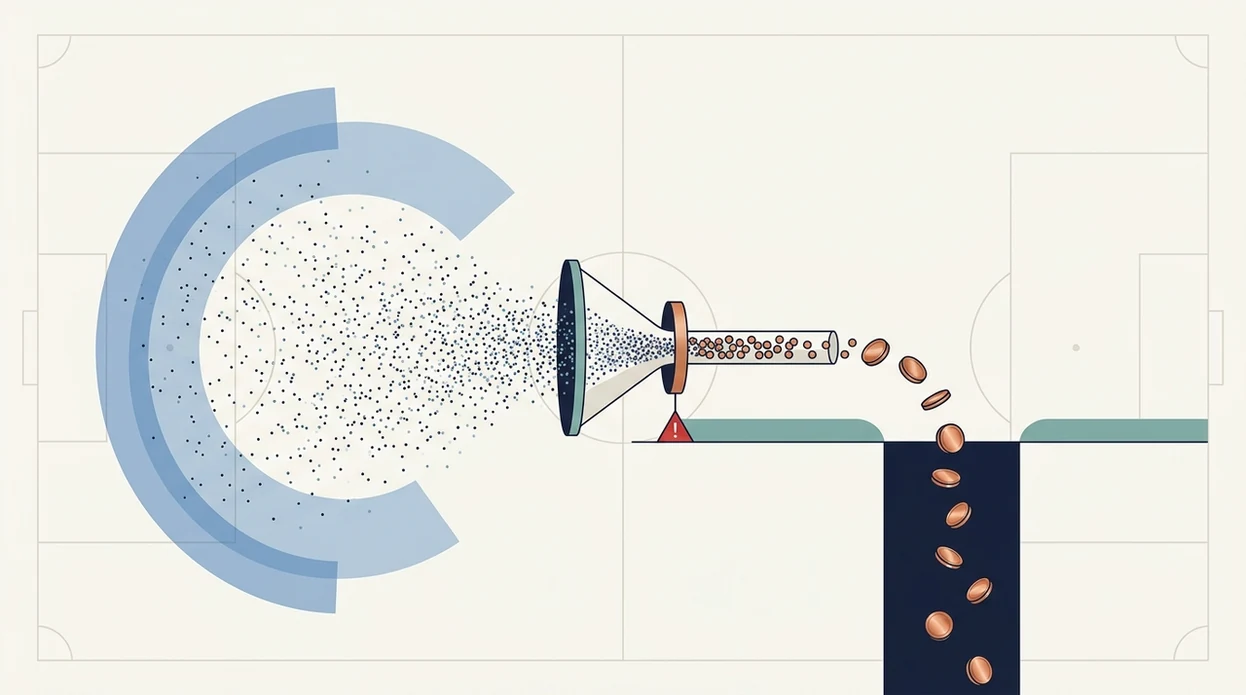
AI football models output probabilities, not certainties. A home win at 58% means the model expects that side to win more often than not across similar matches. It also means the other outcomes still take 42% of the space.
Why 60% Accuracy Still Means Long Losing Streaks
A model that hits 60% of binary picks can still miss four, five, or six bets in a row. That is variance, not betrayal. In football, a centre-back tugging at a hamstring after a recovery sprint can change the match state before the model’s pre-kickoff read has time to breathe.
Research on sports result prediction finds that statistical and machine-learning models can improve forecast accuracy, but they still leave substantial uncertainty because match events, injuries, tactical changes, and small samples are hard to model (Bunker and Thabtah, Applied Computing and Informatics).
The Bookmaker Edge That Predictions Rarely Beat
Bookmakers build margin into prices. That margin is why the combined implied probabilities across all outcomes usually exceed 100%, before a bettor has made any prediction error (Gambling Commission: how gambling works). If your model says 55% and the implied probability in the odds is already close to that, there may be no value after the overround. The phone check at 2:55 p.m., right after lineups drop, can feel sharp. It may still be a bad price.
For most casual bettors, bookmaker margin plus variance overwhelms small prediction edges.
Four Myths About Safe Football Betting Predictions
Myth 1: AI predictions guarantee profit if you follow the system. False. Probability models estimate likely outcomes. They do not remove deflections, missed penalties, red cards, or late injuries.
Myth 2: Low-odds or over 1.5 goals bets cannot lose big. False. Low-odds bets can lose repeatedly, and small losses stack faster than people expect. The bet feels boring until the monthly total looks ugly.
Myth 3: Gambling problems only happen to big spenders. False. Harm is not only about stake size. Borrowing, secrecy, anxiety, and chasing behaviour are stronger warning signs than one large headline loss.
Myth 4: Using data means you are betting logically and are not at risk. False. Data can reduce guesswork, but it can also create false control. A highlighted yellow-card suspension note does not make the price fair.
Good ai football prediction tools deliver probabilities, score ranges, and uncertainty context, not guaranteed profit or a reason to stake money you cannot afford.
Football Prediction Bettors Most at Risk of Gambling Harm
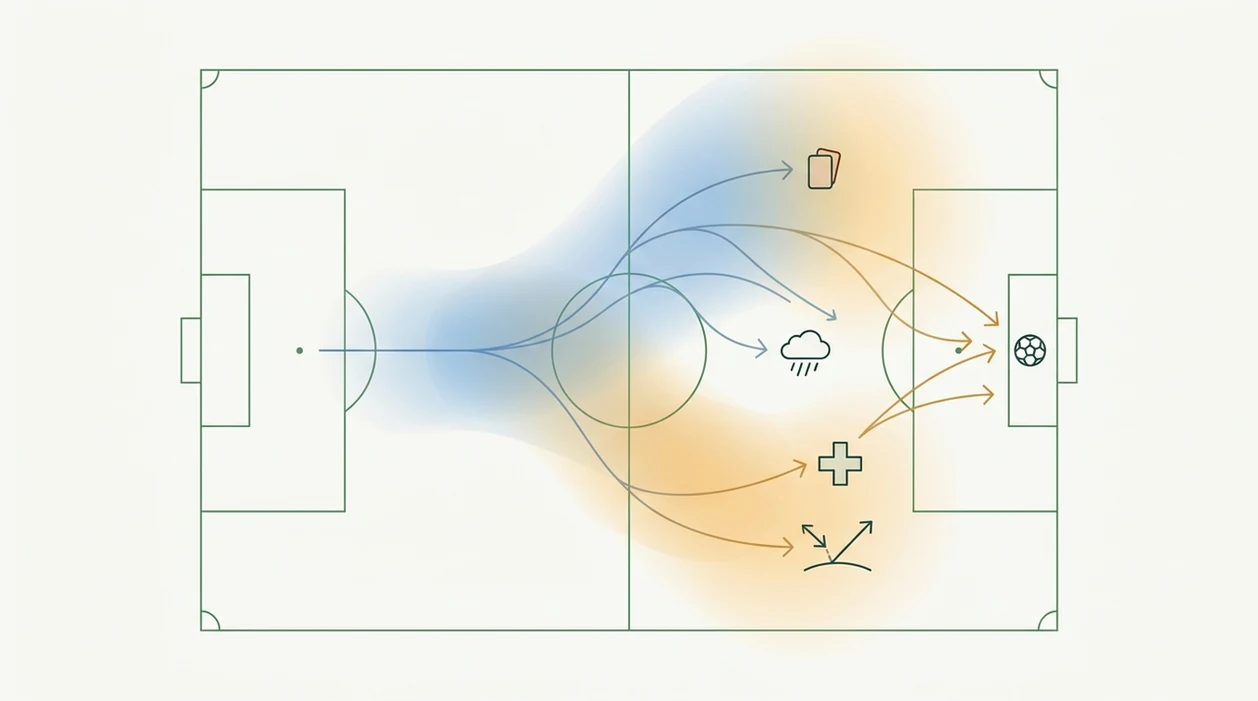
Football prediction bettors are most at risk when they combine frequent online betting, high trust in forecasts, and emotional reactions to losses. In Great Britain, 3.8% of adults were classified as at-risk gamblers in 2023, and 43.5% of online sports bettors showed signs of at-risk or problem gambling in 2024 (Gambling Survey for Great Britain, Gambling Commission).
Higher involvement in online betting is linked with greater gambling-related harm. The danger rises when predictions make betting feel like analysis rather than gambling. A model card with xG profile, rest disadvantage, and correct score distribution can look clinical. The wager is still real money.
The emotional side is easy to miss. Stress, anxiety, sleep disruption, and checking results at midnight are not “part of the game” when they start affecting daily life.
Tools like AI Soccer Predictor can be useful for reading probabilities, but no forecast should reduce healthy scepticism. If the model misses, the safest move is not to double the next stake.
Football Prediction Guarantees: What the Site Does and Does Not Promise
Football Prediction provides AI probabilities and confidence ratings, not betting tips, profit promises, or instructions to wager. A confidence meter means the model sees a stronger probability gap; it does not mean the result is secured.
No accuracy claim equals profit assurance. Even a strong football prediction accuracy record can include losing runs, bad prices, and matches where the correct tactical read fails because one event changes the whole game.
Historical accuracy claims across the prediction industry are often selective, unpublished, or unaudited. That makes them weak evidence for betting decisions unless the method, sample, and missed picks are visible.
The site does not promote sportsbooks or encourage real-money wagering. AI Soccer Predictor ai football prediction is framed as probability information for fans comparing likely scorelines, BTTS, over-under views, and match context before kickoff.
Gambling Help Boundaries: What Prediction Risk Warnings Do Not Cover
Prediction risk warnings can inform safer choices, but they do not prevent addiction on their own. If gambling feels hard to control, professional support matters more than another article, model explanation, or staking spreadsheet.
This page is educational content. It is not clinical advice, legal advice, financial advice, or a substitute for treatment. Clinicians and gambling support services typically recommend seeking help early when betting causes debt, secrecy, distress, or relationship strain.
If you feel out of control, contact GamCare, BeGambleAware, your national gambling helpline, or a licensed mental-health professional; if you may harm yourself or someone else, contact local emergency services immediately. For football-specific habits, our responsible gambling guide explains practical guardrails, but urgent harm needs human support.
Tell someone today. Quiet spirals grow.
How to Avoid Gambling Harm When Using Football Predictions
The safest way to use football predictions is to set limits before you view forecasts, then stop when betting starts affecting money, mood, sleep, or relationships. Predictions should be treated as entertainment probability, never certainty.
- Set your monthly money limit before opening any match forecast, odds screen, or football prediction today page.
- Log every bet with stake, odds, result, and reason, so cumulative losses cannot hide inside memory.
- Treat every probability as uncertain because 65% still loses often enough to hurt if your stake is too large.
- Review your emotional state before betting; stop if you are stressed, chasing, angry, or hiding slips.
- Use self-exclusion tools if limits feel hard to maintain or you keep returning after deciding to stop.
- Seek professional help if betting causes debt, secrecy, relationship conflict, anxiety, or sleep problems.
For casual fans, a written stop rule is often easier than willpower because it removes the halftime negotiation.
Sources and Review Standards for Football Betting Risk Claims
This page bases football betting risk claims on public health, regulatory, charity, and research sources rather than tipster marketing. It also separates prediction performance from any claim about betting profit, because a correct forecast and a profitable wager are not the same thing.
- Use authoritative sources from gambling regulators, government statistics, gambling-harm charities such as GamCare and BeGambleAware, and peer-reviewed sports prediction or gambling-harm research.
- Update harm statistics when the underlying regulator, survey, or charity report changes, rather than freezing risk numbers after publication.
- Keep model accuracy separate from betting outcomes, so match-prediction performance is not presented as proof that users can beat bookmaker margin, odds movement, or variance.
- Label the page clearly as educational content only, not clinical advice, financial advice, legal advice, or a personal recommendation to bet.
- Review risk language before publication and during major updates through an editorial check that covers responsible-gambling wording, source traceability, and whether any sentence could be read as a profit promise.
That review is deliberately cautious. If a line makes betting feel safer than it is, it gets rewritten.
Limitations
Prediction-risk content and AI models have real limits. They can support safer thinking, but they cannot make gambling safe.
- No AI accounts for every last-minute event, including warm-up injuries, red cards, extreme weather, or a keeper injury after substitutions are used.
- Historical accuracy claims are often selective, unpublished, or unaudited, especially when losing picks are removed from public view.
- Bankroll management can reduce volatility, but it cannot turn a negative expected-value method into a profitable one.
- Value betting requires huge sample sizes; casual bettors are usually exposed to variance long before any edge can be proven.
- Educational content may improve decisions, but it does not prevent addiction by itself.
- Responsible gambling tools have limits and require willingness to use them before harm escalates.
- A strong football prediction track record does not guarantee future results, especially after squad changes or tactical shifts.
A forecast recalculating after lineup release is useful. It is not protection from harm.
FAQ
Is football betting risky?
Yes. Football betting always carries financial and psychological risk because match outcomes remain uncertain, even when predictions, statistics, or AI models look convincing.
Can AI predictions guarantee betting profit?
No. AI predictions estimate probabilities, but they cannot eliminate variance, bookmaker margin, injuries, red cards, weather, or other unpredictable match events.
What are the main risks of gambling?
The main gambling risks are financial loss, debt, stress, anxiety, relationship damage, secrecy, chasing losses, and possible gambling addiction.
Do prediction sites actually beat bookmakers?
Some models may identify value occasionally, but bookmaker overround makes consistently beating prices extremely difficult across a large sample.
How do I know if I have a gambling problem?
Warning signs include chasing losses, hiding bets, borrowing money, betting more than planned, feeling anxious, or struggling to stop.
What is the 80/20 rule in gambling?
The 80/20 rule describes how a small share of bettors can generate most gambling losses, highlighting concentrated harm among vulnerable users.
Are low-odds bets safer than high-odds bets?
Low-odds bets may win more often, but repeated losses and increased stake sizes can still cause significant cumulative harm.
Where can I get help for gambling harm?
Contact GamCare, BeGambleAware, a national gambling helpline, or a licensed mental-health professional if betting feels difficult to control.